Best Leverage for Small Account: How to Turn Small Into Big
If you’re trading with a small balance, you’ve likely asked: What is the best leverage for small account trading?
The right answer can mean the difference between growing your money or losing it in days. Many new traders rush to use high leverage, hoping to turn $10 into $1,000. But without a plan, that dream often ends in a blown account.
This guide breaks down the best leverage for small account, the risks of using too much, and how beginners can grow small money safely.
On Dominion Options, you can also use higher leverage up to 500:1, but only with strict control. They offer tight 0.1 spreads and you may notice some latency in execution. If you stay disciplined, you can still manage risk even with these conditions.
What Is Leverage in Trading

What Is Leverage in Trading
Leverage lets you control more than you actually own. In practice, it means your broker lends you buying power to open positions larger than your deposit. On small accounts, even modest leverage can feel big. Ratios as high as 500:1 are available, but they demand extra care. Only use them if you have a plan, set stops, and know your margin. Keep an eye on spreads and execution speed since even small delays can hurt a small account. For more on this topic, see our guide on forex trading leverage explained.
Example of leverage in trading:
- With $100 and no leverage, you trade $100.
- With 1:10 leverage, you trade $1,000.
- With 1:100 leverage, you trade $10,000.
It’s like using a car jack. You lift more than you could alone. But if it slips, the weight crushes you. In trading, that slip can be a small price move, a delay in execution, or even a wider spread. With high leverage, those tiny changes hit harder. That’s how leverage can either grow your balance or wipe it out in seconds. This is why many guides on leverage trading for beginners warn against pushing leverage too high too soon.
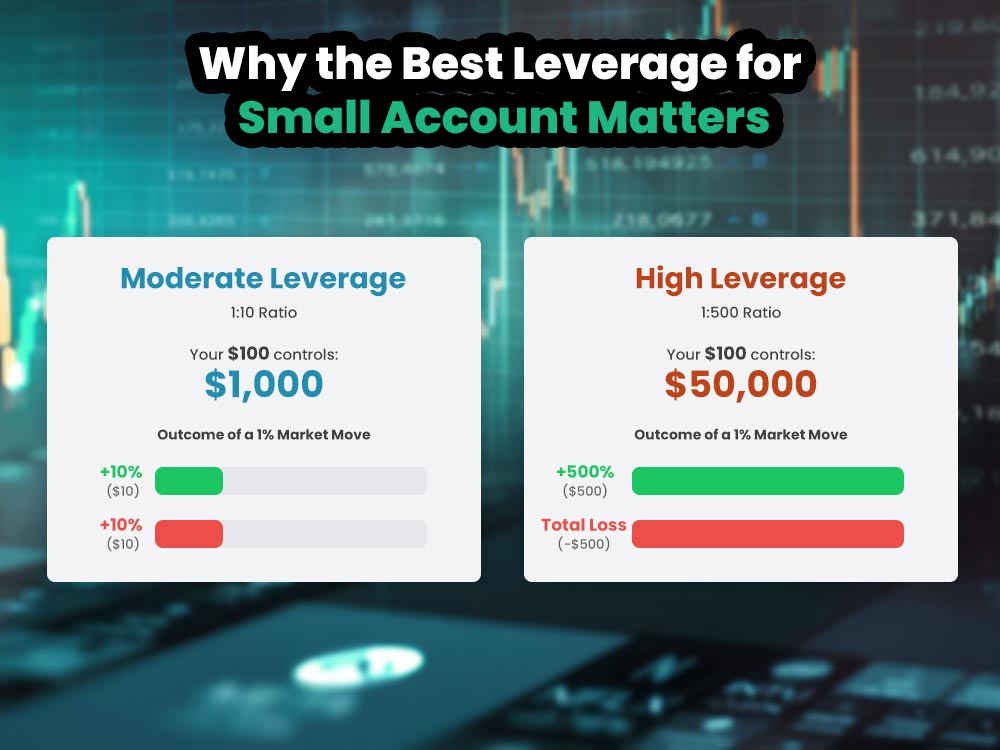
Why the Best Leverage for Small Account Matters
Why the Best Leverage for Small Account Matters
Many brokers promote sky-high leverage like 1:500 or 1:1000. At first, this feels like a way to make big profits with little capital.
But here’s the truth: the higher the leverage, the faster you can lose everything. Even a 1% move can wipe a small account with extreme leverage. A spike in spreads or a short delay in order execution can add to the damage. The bottom line: high leverage makes your wins bigger, but it makes your losses lethal and often unexpected.
Why Small Accounts Tempt Traders Into Big Leverage
If you start with $10, $30, or $100, you may feel like you need high leverage.
- $10 at 1:10 leverage = $100 buying power.
- $10 at 1:500 leverage = $5,000 buying power.
The second option looks exciting. But think about this: if the market moves only 0.5% against you, your balance is gone.
This is why the best leverage for small account is not the maximum your broker allows. It’s the one that protects you from being wiped out. If you’re unsure, read our guide on choosing the best leverage for forex carefully to avoid common mistakes.
Survival First, Profits Later
The best traders don’t focus on fast profits. They focus on staying in the game.
Your goal with a micro or small account is to survive long enough to build skill. When you use safe leverage, you give yourself time to learn, grow, and compound your balance. It also cushions you against common mistakes like holding trades too long or misplacing a stop. With lower pressure from margin calls, you can focus on building skill instead of chasing survival.
This is why many experts say the best leverage for micro account and small accounts is 1:10 or lower.
Best Leverage for Small Account by Balance
Different account sizes call for different leverage. A trader with $20 cannot manage risk the same way as someone with $500 or $1000. The smaller the balance, the less room there is for error. That’s why your leverage choice should always match your account size. Here’s a guide based on industry experts:
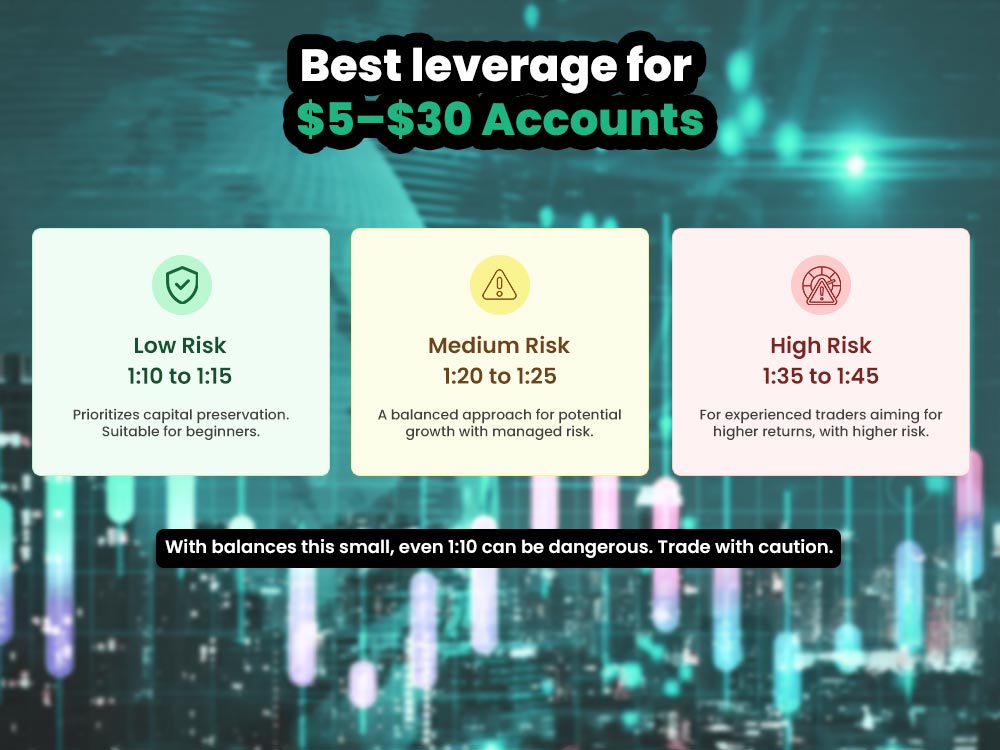
Best leverage for $5–$30 Accounts
- Low risk: 1:10 to 1:15
- Medium risk: 1:20 to 1:25
- High risk: 1:35 to 1:45
With balances this small, even 1:10 can be dangerous. Trade with caution.
Best leverage for $5–$30 Accounts
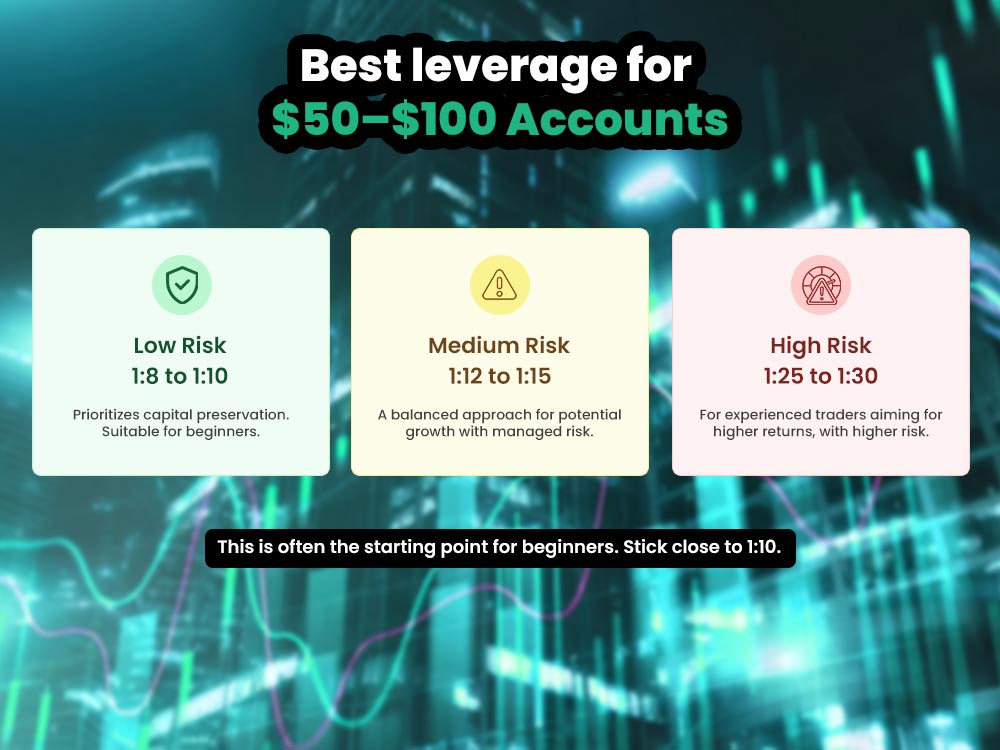
Best leverage for $50–$100 Accounts
- Low risk: 1:8 to 1:10
- Medium risk: 1:12 to 1:15
- High risk: 1:25 to 1:30
This is often the starting point for beginners. Stick close to 1:10.
Best leverage for $50–$100 Accounts
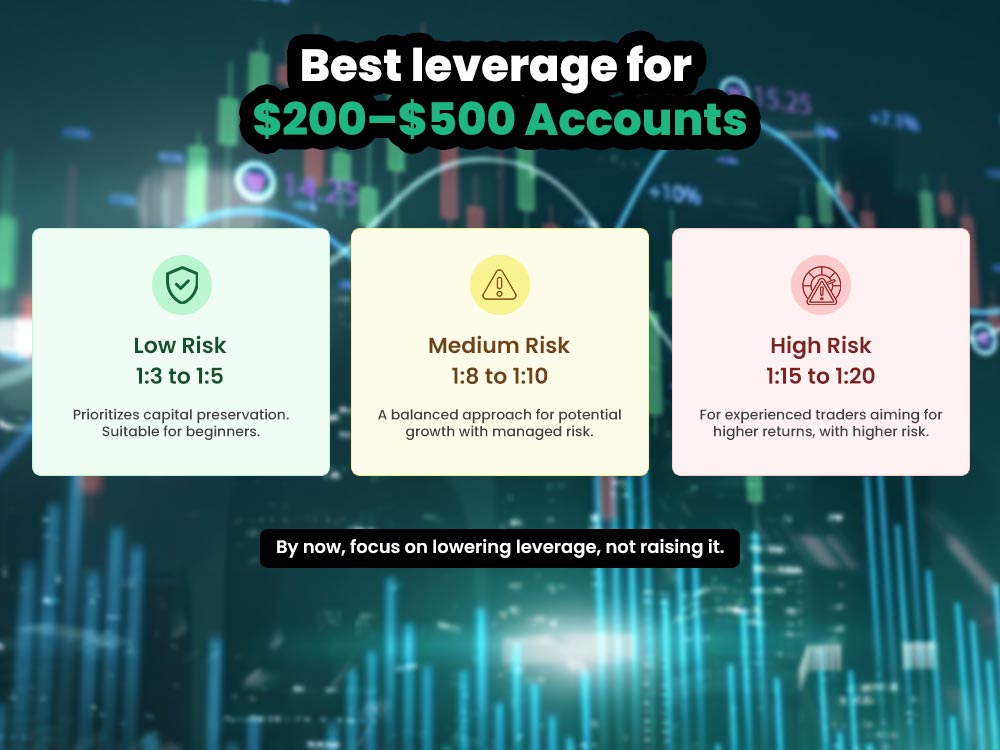
Best leverage for $200–$500 Accounts
- Low risk: 1:3 to 1:5
- Medium risk: 1:8 to 1:10
- High risk: 1:15 to 1:20
By now, focus on lowering leverage, not raising it.
Best leverage for $200–$500 Accounts
Best leverage for $1000+ Accounts
- Low risk: 1:2 to 1:3
- Medium risk: 1:4 to 1:6
- High risk: 1:10 to 1:12
With larger accounts, the best leverage for small account growth is actually much smaller. Protecting capital is the priority because the bigger your balance, the less you need borrowed power to see results. Larger balances magnify both gains and losses, so a safer approach is to reduce exposure and keep risk steady. If you want to learn the math behind it, check our guide on calculating leverage in forex trading.
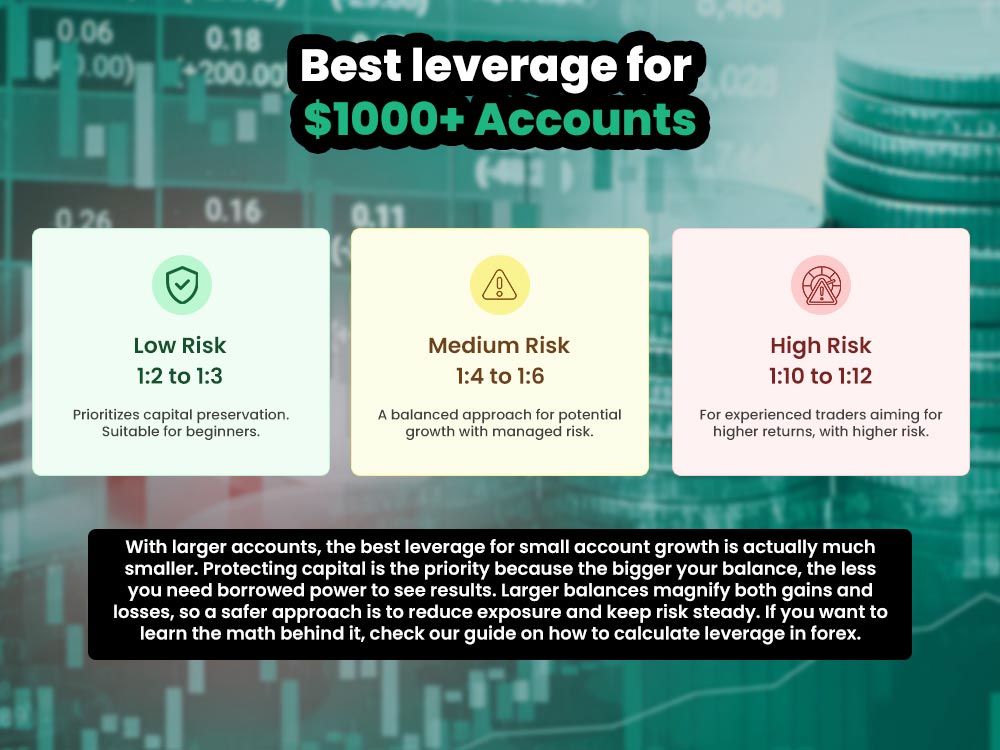
Best leverage for $1000+ Accounts
The Best Leverage for Beginners by Experience
Your trading experience matters as much as your balance.
- Year 1: 1:2 to 1:5
- Year 2: 1:6 to 1:15
- Year 3: 1:16 to 1:25
- Year 4+: Only raise leverage if you’re consistently profitable
This staged approach keeps you safe. It matches the advice from most experienced traders: keep leverage low until you prove you can win without blowing up.
Risk Management With Small Accounts
Leverage is only one side of the coin. Risk management is the other.
Follow these rules with small accounts:
- Risk 1–2% per trade. A $100 account means $1–$2 risk.
- Always use stop-loss orders. Don’t let one trade destroy you.
- Stick to micro lots (0.01). They give you control.
- Keep margin above 300%. Under 100% is margin call danger.
- Avoid overtrading. Fewer good setups beat many random trades.
Even with the best leverage for small account trading, bad risk habits will ruin you. Overtrading, skipping stops, or chasing losses can drain an account quickly. These are some of the risks associated with high leverage in forex, and they only get worse when discipline is missing.
Demo Accounts: The Training Ground
Before you risk real money, test your leverage on a MT5 demo account.
If you plan to trade with $50, set your demo balance to $50. Use 1:10 leverage. Track your trades for a month. If you can’t grow fake money, you won’t grow real money.
Demo trading helps you practice safe habits before emotions get involved.
How to Grow Small Into Big
Here’s the formula that works:
- Start with $50–$100.
- Use 1:10 leverage (the best leverage for beginners).
- Risk only 1–2% per trade.
- Focus on quality setups, not quantity.
- Compound profits slowly.
Example:
- Gain 5% per month on $100 = $5.
- After 1 year = ~$180.
- After 2 years = ~$325.
- After 3 years = ~$590.
Add deposits over time, and your account can grow steadily. That’s how small turns into big through consistency, not gambling. As balances grow, you may compare ratios like 1:100 Leverage vs 1:500 to see how different settings affect both risk and growth. The key is choosing the option that fits your plan and risk tolerance.
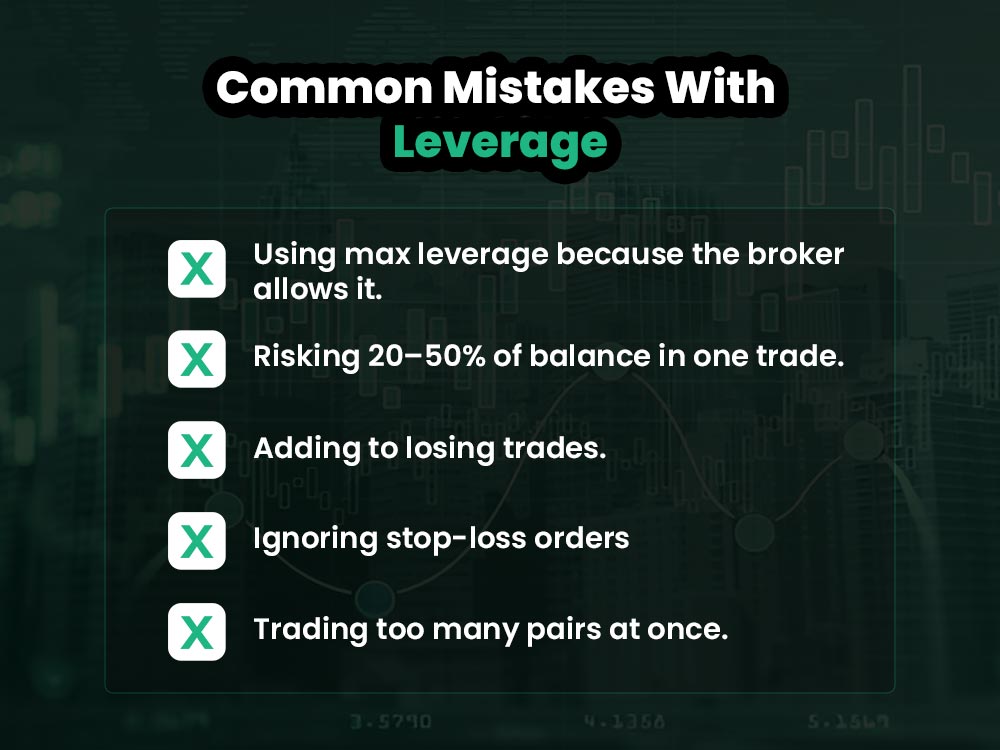
Common Mistakes With Leverage
Who Should Use Which Between 1:100 Leverage vs 1:500
Beginners often make the same errors:
- Using max leverage because the broker allows it.
- Risking 20–50% of balance in one trade.
- Adding to losing trades.
- Ignoring stop-loss orders.
- Trading too many pairs at once.
Even the best leverage for micro account won’t save you if you fall into these traps.
Why Brokers Offer High Leverage
If high leverage is so risky, why do brokers promote it?
It attracts new traders with the promise of quick gains. A 1:1000 offer looks like easy money, and many sign up without thinking about the risks. Brokers earn from spreads and commissions, so the more you trade, the more they profit. Some even market themselves as the best forex brokers with high leverage to give traders more flexibility and choice.
This doesn’t make them bad, but it means you must protect yourself. Just because 1:1000 is available doesn’t mean it’s the best leverage for small account growth.
The Psychology of Leverage
The math is one thing. Your mind is another.
High leverage feeds greed. It makes you chase fast wins. But it also breeds fear. Large positions make small price moves feel terrifying.
Low leverage calms the mind. It gives you control. It lets you focus on the trade, not the panic. That’s why the best forex leverage for beginners is not about chasing riches but about keeping balance.
Quick Checklist: Best Leverage for Small Account
Here’s a simple recap:
- Start with 1:10 or less.
- Risk 1–2% per trade.
- Use micro lots.
- Trade fewer, higher-quality setups.
- Compound profits over time.
This applies whether you’re asking for the best leverage for micro account or starting with $100.
Final Thoughts
Leverage is just a tool. Like a hammer, it can build or destroy.
The best leverage for small account is not the biggest your broker allows. It’s the one that keeps you safe while helping you grow.
For most beginners, that means 1:10. It gives balance between opportunity and safety.
Ignore the noise. Ratios like 1:500 or even 1:1000 can be powerful if used wisely. High leverage gives traders the chance to open positions with less capital and still see meaningful returns. The key is education and discipline. For beginners, the best leverage for beginners is still small and controlled, but as skills grow, higher leverage can become a useful tool rather than a trap.
That’s how you turn small into big—not overnight, but over time, with patience, discipline, and smart risk control.
A natural next step is choosing the right forex broker. Dominion Options stands out here, offering up to 500:1 leverage, tight 0.1 spreads, and reliable execution, giving small account traders the tools they need to grow with confidence.