1:100 Leverage vs 1:500 – The Big Advantage You Are Missing
Tradingg forex lets you control large positions with small amounts of money. This is possible because of leverage. Brokers offer different leverage levels, and one of the most common debates is 1:100 leverage vs 1:500.
At first glance, these two numbers might seem like a simple choice. But the gap between them is bigger than most traders realize. The difference shapes how you trade, the risks you take, and the profits you can make.
This article will break down 1:100 leverage vs 1:500 in plain terms. You’ll see how each works, the risks, and how to choose the right one for your style. For a real-world point of reference, brokers like Dominion Options offer up to 500:1 leverage with tight spreads. That combination can give disciplined traders both cost efficiency and the flexibility to manage positions more effectively.
Forex Leverage Explained: What Leverage Really Means
Forex Leverage Explained: What Leverage Really Means
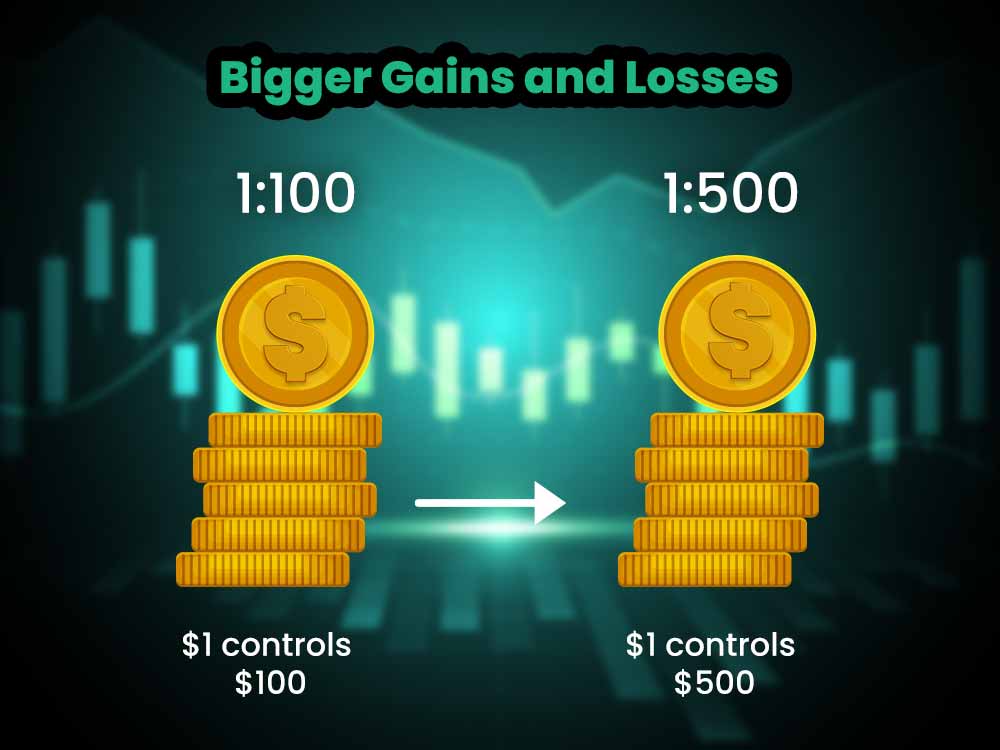
Leverage is borrowed money from your broker. You use it to open trades much larger than your own capital.
With 1:100, every $1 you have controls $100 in the market.
With 1:500, every $1 controls $500.
Both multiply gains and losses. Small price moves can turn into big results—good or bad. You can read more about this in our blog post on forex leverage explained.
The Leverage Math in Action with AUX/USD
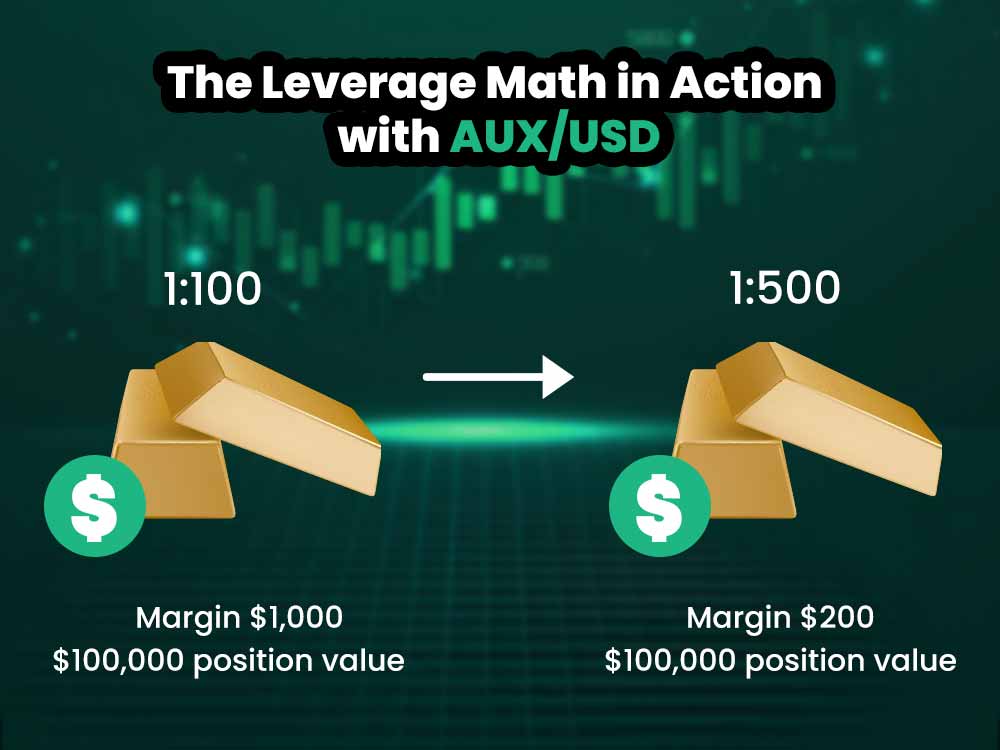
Here’s an example using a standard lot in Gold/USD (XAU/USD). In this case, one standard lot equals 100 ounces of gold. If gold is trading at $1,000 per ounce, that’s a $100,000 position value.
- 1:100 leverage
Margin requirement: 1% of the trade size.
To open a $100,000 Gold/USD position, you need $1,000. - 1:500 leverage
Margin requirement: 0.2% of the trade size.
To open the same $100,000 Gold/USD position, you need only $200.
What Leverage Means in Forex
This margin gap is why many traders pay attention to 1:100 leverage vs 1:500 as a key decision point. For gold traders, pairing the right leverage with a solid xau/usd trading strategy can help balance profit potential with risk control.
Why Traders Choose Higher Leverage
With 1:500, you can risk less capital per trade. You can spread your account across more trades. You can adapt to fast market changes without locking up too much margin.
For example, with $1,000 in your account:
- At 1:100, you can open one standard lot and have no margin left.
- At 1:500, you can open the same lot and still have $800 free margin. If you’re unsure which option suits your style, check our guide on how to choose the best forex leverage for practical tips and examples.
The Risk Behind High Leverage
The danger is simple. Higher leverage allows bigger positions than you may be ready for.
If the market moves against you, losses grow fast. A small move of 20 pips on a large trade can wipe out a big chunk of your account.
Many traders fail with 1:500 because they treat it like a license to go all in. For more on the dangers, see our blog post on what are the risks associated with high leverage.
1:100 Leverage vs 1:500 – Understanding the Comparison
When looking at 1:100 leverage vs 1:500, the key difference is margin requirement and flexibility.
At 1:100, you need more capital to open the same trade. This naturally slows down how quickly you can enter large positions, acting as a built-in brake against overexposure. It encourages more deliberate trade planning, but at the cost of flexibility—there’s less room to open multiple trades or adjust positions without adding more funds.
At 1:500, you need less margin to open the same trade. This leaves more of your account free for other positions, scaling into trades, or simply keeping as a safety buffer. It gives you room to hold trades longer during market swings without hitting a margin call, as long as you manage position sizes responsibly.
Both can work if used wisely. 1:100 acts like a guardrail, slowing account swings and naturally limiting oversized trades. It forces you to plan entries and manage risk with more care. 1:500 offers speed and space by freeing up more margin for flexibility, but it rewards discipline—if you overextend, the losses can come just as fast as the wins.
1:100 – The Safer Option for New Traders
With 1:100, your trade sizes are limited by margin requirements. This acts as a built-in guardrail.
It’s enough power to make meaningful gains but still keeps exposure in check. For beginners, this makes 1:100 a good place to start. You can also read our blog on leverage trading for beginners to understand how to use it safely.
1:500 – The Flexible Tool for Skilled Traders
For experienced traders, 1:500 offers more than just bigger trades. It provides margin freedom.
You can scale into trades, hedge positions, or run multiple setups without choking your account. Scalpers often prefer it because they open and close many trades in a short time.
Real Trade Example – 1:100 Leverage vs 1:500 in Action
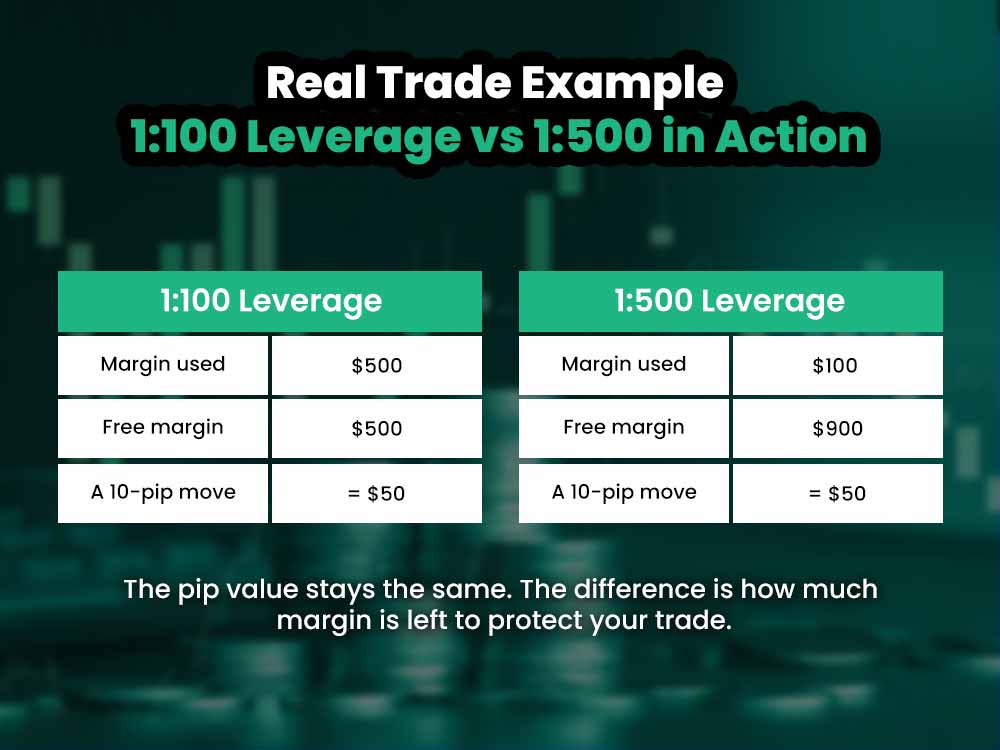
Let’s compare the same account size with different leverage.
Real Trade Example – 1:100 Leverage vs 1:500 in Action
- 1:100:
Open 0.5 lots. Margin used: $500. Free margin: $500. A 10-pip move = $50. - 1:500:
Open 0.5 lots. Margin used: $100. Free margin: $900. A 10-pip move = $50.
The pip value stays the same. The difference is how much margin is left to protect your trade.
Why Margin is Your Safety Net
Margin is not just an entry requirement—it’s your first line of defense against forced liquidation. It acts like a cushion between your active trades and the broker closing them out when losses mount.
With 1:500, you keep more margin available, so you can hold trades through short-term swings or temporary pullbacks without triggering a margin call. This extra space can buy time for a trade to recover if your analysis is correct. With 1:100, the safety buffer is smaller, meaning price moves have less room before they threaten your position.
The Psychology Factor of High Leverage Trading
Leverage affects how traders think and act. High leverage can create a false sense of security, tempting you to take on more trades or larger positions than your plan allows. Low leverage forces you to be selective, which can protect you from rash decisions.
The most disciplined traders approach 1:500 as if it were 1:100. They view the extra margin not as a green light to risk more, but as a safety cushion to help their trades survive normal market swings.
Regulation and Limits
Some regions cap leverage to protect retail traders from extreme risk. In the U.S., retail traders are limited to 1:50 on major currency pairs. The EU sets an even lower cap at 1:30. These rules aim to prevent large losses for less experienced traders.
Outside these regulated areas, many brokers offer up to 1:500. This puts the choice and the full responsibility on you. The higher limit can be a valuable tool if you understand margin and risk, but without discipline it can quickly work against you.
You can explore our guide on high leverage forex brokers to learn which providers offer these options and how to choose one that matches your trading style.
Using 1:500 Leverage the Right Way
- Risk 1% or less per trade.
- Always set a stop-loss.
- Keep most of your margin free.
- Treat it like lower leverage in practice.
- Use position size calculators.
Using 1:100 Leverage Effectively
- Avoid maxing out margin.
- Focus on high-quality setups.
- Be patient with account growth.
- Keep a trading journal.
Who Should Use Which Between 1:100 Leverage vs 1:500
- 1:100 is better for beginners or cautious traders who need built-in limits to help manage risk. The higher margin requirement naturally slows trading pace and encourages careful position sizing.
- 1:500 suits experienced, disciplined traders who can control position sizes and avoid overtrading. It offers greater flexibility, more free margin, and the ability to run multiple strategies without tying up capital.
Who Should Use Which Between 1:100 Leverage vs 1:500
The Real Advantage in 1:100 Leverage vs 1:500
The hidden benefit of 1:500 is not bigger profits. It’s having more room to manage trades.
More free margin means you can hold trades longer, adjust positions, and stay safe from sudden stop-outs. You can learn more about managing this balance in our guide on how to calculate leverage in forex.
Final Thoughts
Leverage is a tool. The choice between 1:100 leverage vs 1:500 depends on your skill, strategy, and discipline.
If you’re new, 1:100 gives you structure. If you’re skilled, 1:500 can be a safety net—if you use it with control.
Traders looking for competitive conditions might consider Dominion Options, which offers up to 500:1 leverage alongside tight spreads. This combination can lower trading costs and give experienced traders the flexibility to manage multiple positions without locking up too much capital.