
How to Trade With the Alligator Indicator in the Forex Market
The alligator indicator is one of the few trading tools designed to answer a question most traders ignore: Should you even be trading right now? Instead of focusing on constant entries, the alligator indicator helps you identify when the forex market is worth trading and when it is better left alone.
In this guide, you’ll learn how to trade with the alligator indicator in the forex market using clear logic, real market behavior, and disciplined trend-following principles. We’ll also cover how the alligator indicator works, how to read it correctly, and how to apply the best alligator indicator settings without overcomplicating your charts.
To apply these concepts effectively, many traders prefer trading platforms like Dominion Options, which offers fast execution, competitive spreads, and professional-grade platforms such as MT5 - features that are especially useful when trading trend-following strategies like the alligator indicator, where precise entries, smooth execution, and reliable charting tools matter.
What Is the Alligator Indicator?
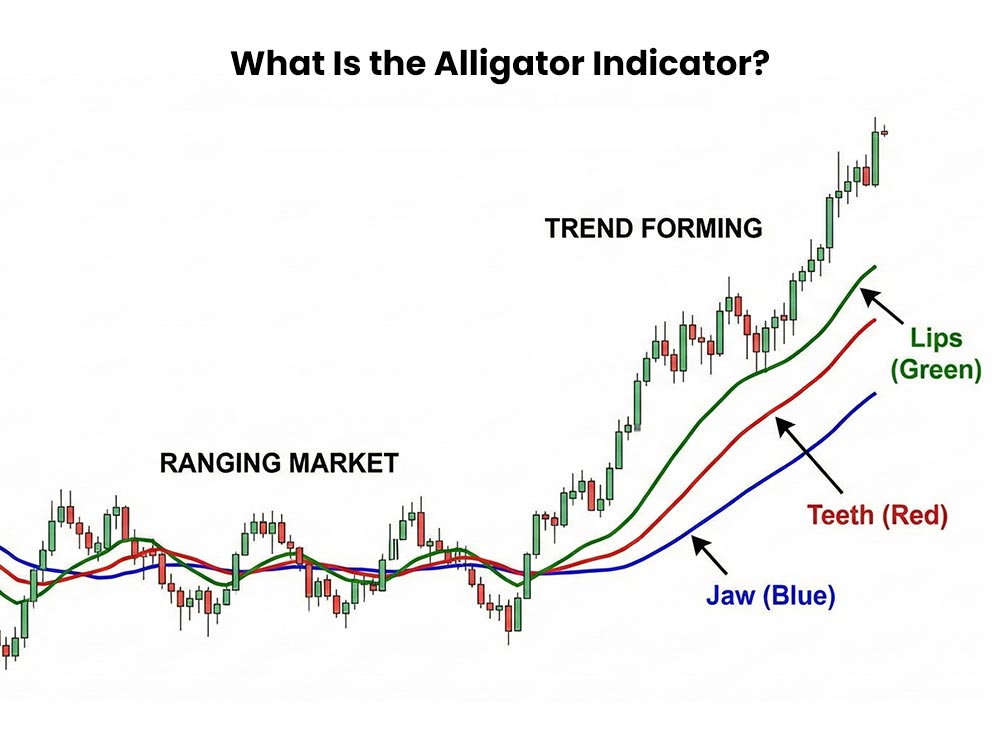
What Is the Alligator Indicator?
The alligator indicator is a trend-following alligator technical indicator developed by Bill Williams. It uses three smoothed moving averages to show whether the market is trending or consolidating.
The philosophy behind the alligator indicator is simple: Most markets spend the majority of time moving sideways, and traders lose money by forcing trades during those conditions. The indicator visually separates trending phases from non-trending phases, helping traders stay patient.
This concept sits at the core of forex trading technical analysis, where understanding market structure and conditions comes before choosing any single setup or indicator.
How the Alligator Indicator Works
Understanding how the alligator indicator works is essential before using it for entries or exits.
The Alligator indicator is built around the metaphor of an alligator’s behavior:
- When the alligator is sleeping, the market is ranging
- When it wakes up, a trend may be forming
- When it feeds, the trend is strong
- When it becomes sated, the trend is losing momentum
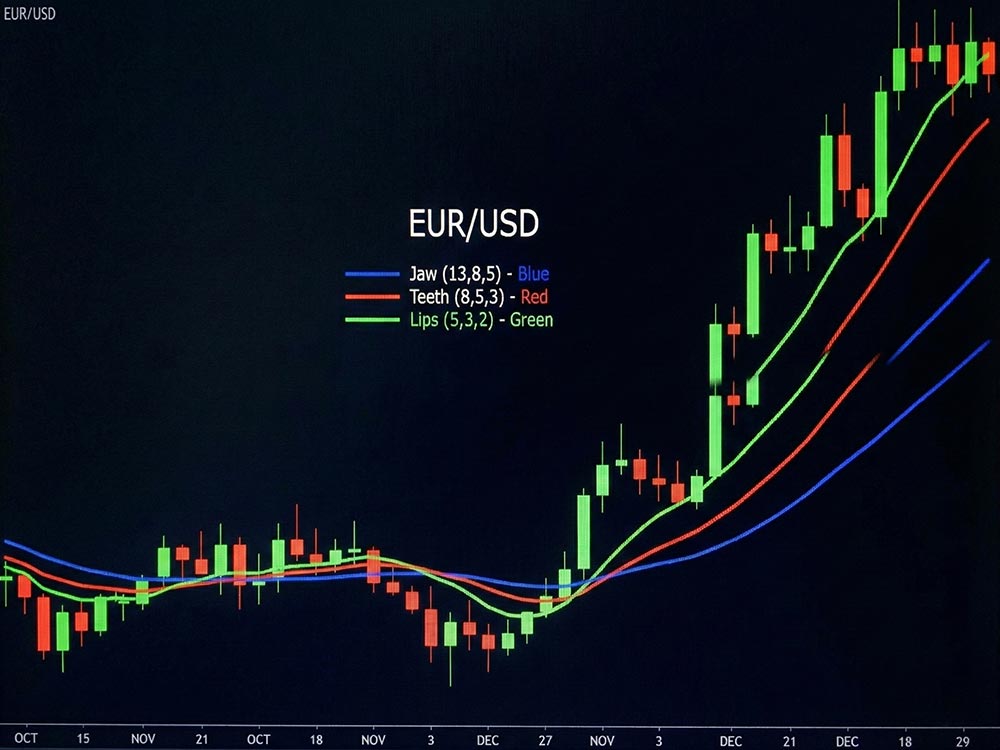
The alligator indicator visually represents these phases using three lines that expand and contract based on market conditions. When the lines are tightly compressed and frequently crossing, it reflects indecision and a lack of directional strength in price.
How the Alligator Indicator Works
As momentum begins to build, the lines start to separate, showing that buyers or sellers are gaining control. The wider the distance between the lines and the cleaner their slope, the stronger and more established the trend becomes, making it easier to distinguish between ranging markets and high-probability trending environments.
The Three Lines of the Alligator Technical Indicator
The alligator indicator consists of three smoothed moving averages, each serving a specific role in trend identification.
1. Jaw (Blue Line)
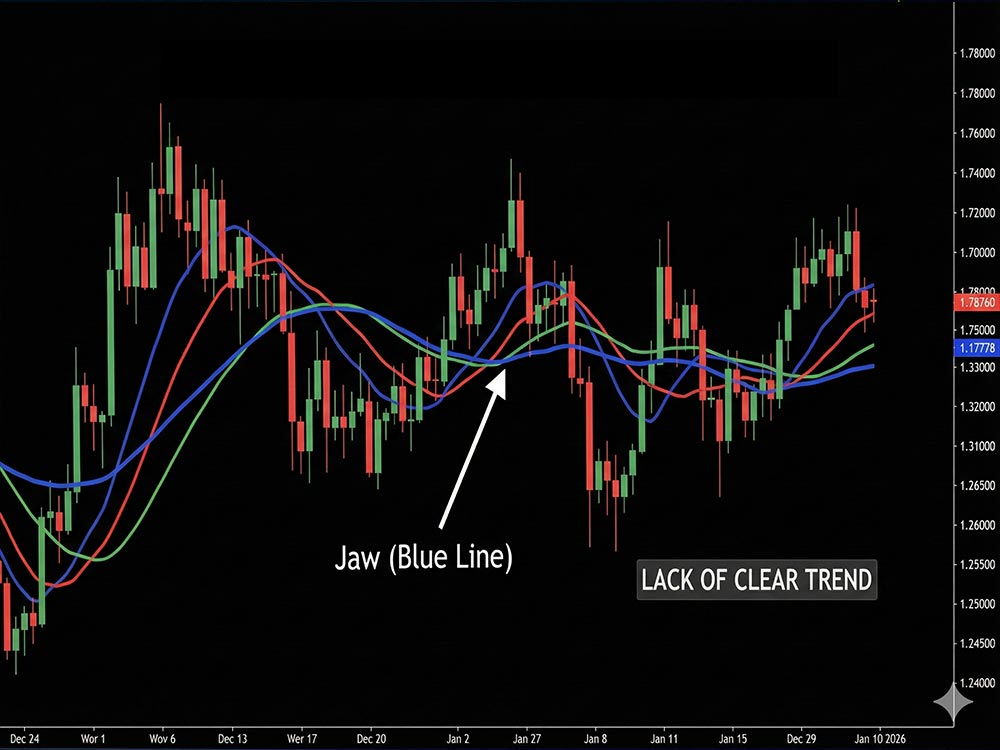
Jaw (Blue Line)
The jaw is the slowest line and represents long-term market balance. It reflects where price tends to gravitate when the market has no clear directional bias.
When price is hovering close to the jaw, it usually signals indecision, equilibrium between buyers and sellers, and a lack of sustained momentum. In practical terms, this is often where trends pause, stall, or fail to develop.
When price moves decisively away from the jaw and stays separated from it, momentum is present. The greater the distance between price and the jaw, the stronger and more established the trend tends to be.
Many traders also treat the jaw as a dynamic reference point for overall trend health, watching whether price consistently respects it or begins to cut back through it.
2. Teeth (Red Line)
Teeth (Red Line)
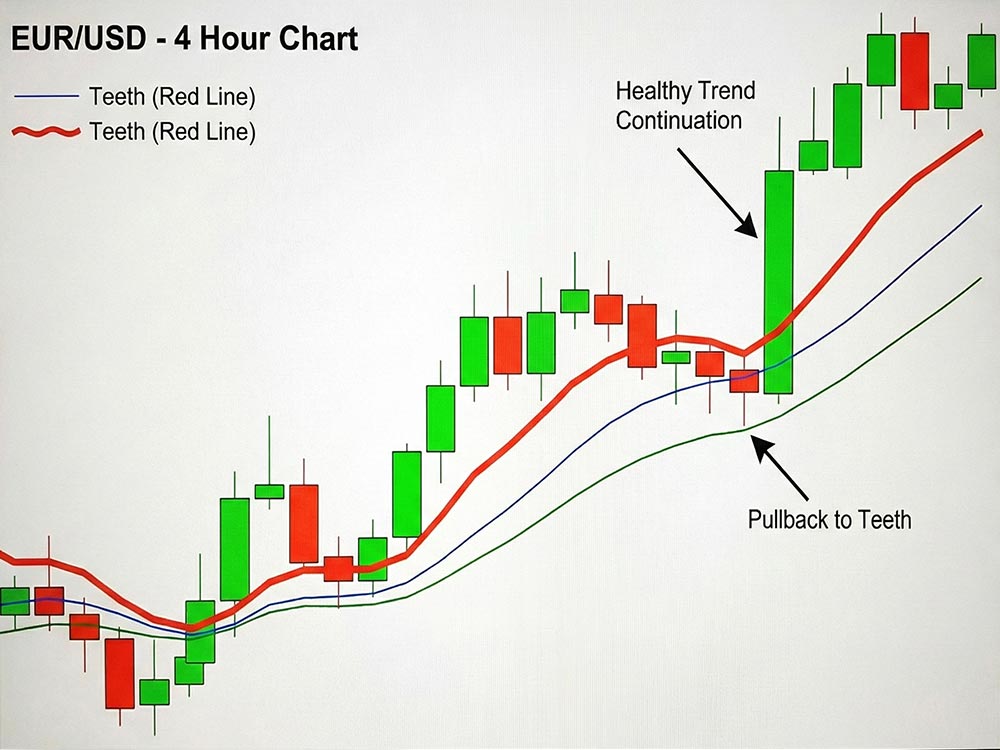
The teeth represent the medium-term trend and often act as a guide for trend continuation. During strong forex trends, price frequently pulls back toward the teeth before resuming in the direction of the prevailing move.
These pullbacks are not signs of weakness but rather pauses where the market resets before continuing.
Because of this behavior, the teeth are commonly used to judge whether a trend remains intact. As long as price respects the teeth and does not close decisively beyond them in the opposite direction, the trend structure is usually considered healthy.
3. Lips (Green Line)
Lips (Green Line)
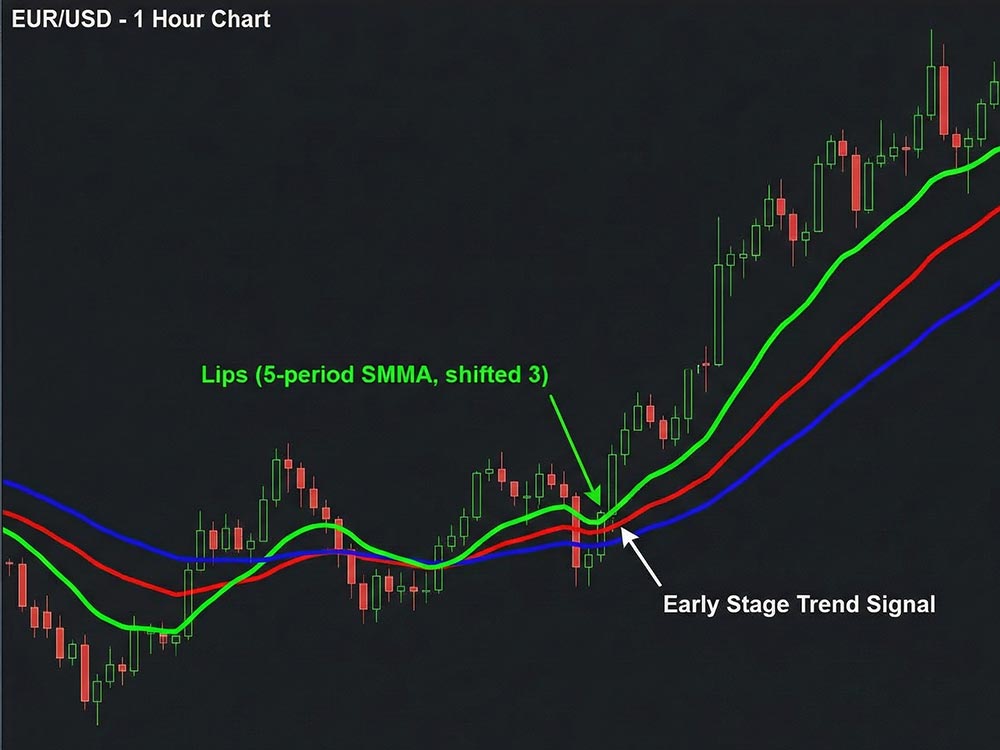
The lips are the fastest line and respond first to changes in price behavior. They are often the earliest signal that momentum is shifting, either at the start of a new trend or during the final stages of an existing one.
When the lips cross and begin to separate from the teeth and jaw, it can indicate that directional pressure is building.
This line plays a key role in how to read the alligator indicator, especially during early trend formation, as it helps traders detect momentum shifts before they are fully reflected in the slower lines.
All three lines are shifted forward, helping traders visualize momentum rather than reacting too late.
How to Read the Alligator Indicator in Forex Trading
Learning how to read the alligator indicator correctly is more important than memorizing entry rules.
The Sleeping Alligator (No-Trade Zone)
When the jaw, teeth, and lips are tangled together or crossing repeatedly, the alligator indicator is signaling a sideways market.
This phase tells you:
- Momentum is weak
- Breakouts are unreliable
- Trading carries higher risk
Professional traders treat this as a stand-aside zone. One of the biggest advantages of the alligator indicator is avoiding these low-quality conditions.
Identifying Trend Direction With the Alligator Indicator
The alligator indicator becomes useful when the market transitions from sleep to movement.
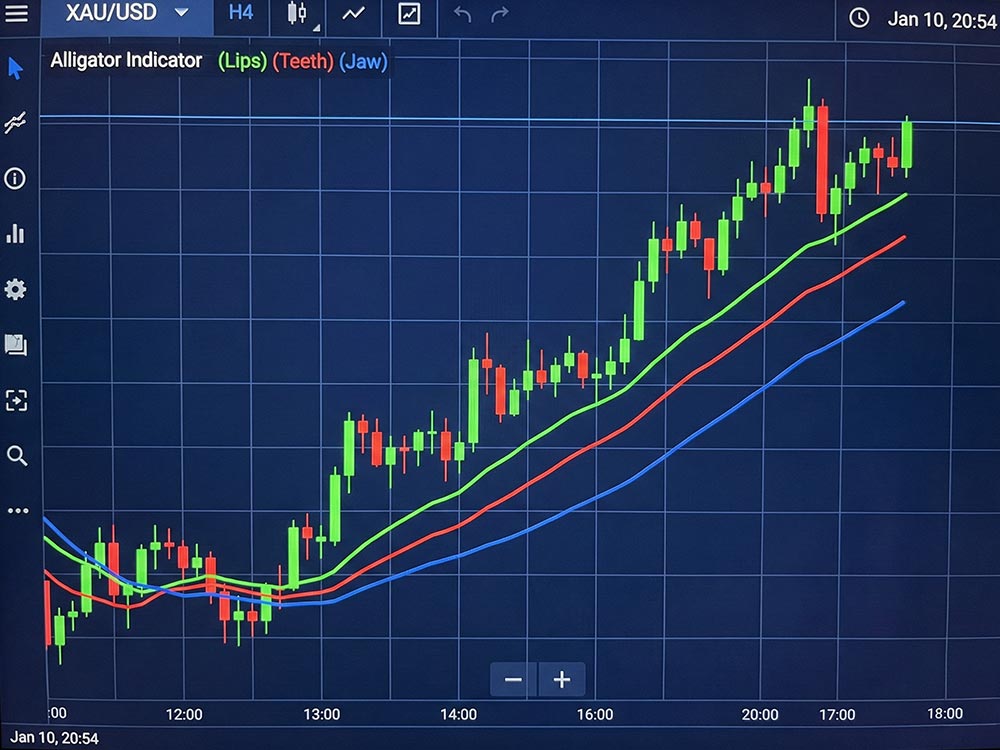
Bullish Trend Conditions
A bullish trend is forming when:
- The green line crosses above the red and blue lines
- The lines separate and slope upward
- Price holds above the alligator indicator
This alignment shows buyers are in control and the market is waking up.
Bullish Trend Conditions
Bearish Trend Conditions
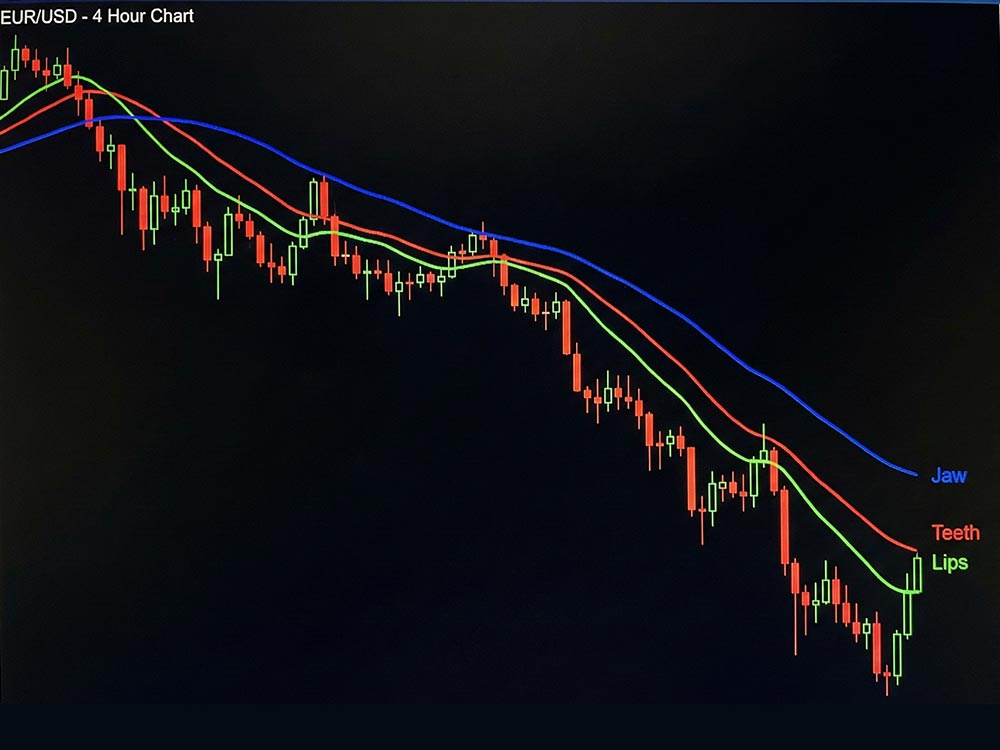
A bearish trend is forming when:
- The green line crosses below the red and blue lines
- The lines spread downward
- Price stays below the indicator
This structure signals increasing selling pressure.
Bearish Trend Conditions
This phase is where how to trade with alligator indicator strategies become effective, especially when combined with broader forex trading chart patterns, helping confirm whether a move has structural backing.
How to Trade With the Alligator Indicator: Entry Logic
The alligator indicator works best as a trend confirmation tool, not a prediction tool.
Conservative Entry Method
A high-probability approach is to:
- Wait for clear separation between the three lines
- Confirm all lines are sloping in the same direction
- Enter after a pullback toward the red or green line
For buy trades:
- Trend must be bullish
- Price pulls back toward the indicator
- Price resumes upward movement
For sell trades:
- Trend must be bearish
- Price retraces toward the indicator
- Momentum resumes downward
This approach filters out false signals and aligns entries with trend strength. Traders who want to expand beyond a single tool often pair this logic with insights from best indicators for day trading, using additional confirmation without overcrowding the chart.
Staying in Trades Using the Alligator Indicator
One reason traders struggle is exiting too early. The alligator indicator helps you stay in winning trades longer.
As long as:
- The three lines remain separated
- The slope stays consistent
- Price does not close deeply inside the indicator
The trend is likely still active. This “feeding” phase is where most trend profits are made because price is moving with clear direction and reduced hesitation. During this phase, pullbacks are usually brief and controlled, momentum stays steady, and price continues to move in one clear direction.
Traders who remain aligned with the trend are often rewarded, while those reacting to small counter-moves tend to exit prematurely.
Leaving a position too early in this phase often means missing the most productive portion of the move, as trends usually generate their strongest progress only after structure and momentum are clearly in place.
Exit Signals With the Alligator Indicator
Every trend ends, and the alligator indicator helps you recognize that shift before momentum fully collapses. Rather than relying on guesswork or fixed targets, the indicator shows when directional pressure is fading and when continuation becomes less likely.
Common Exit Signals
- The green line starts crossing back toward the red line, indicating that short-term momentum is weakening
- The distance between the three lines decreases, showing reduced trend strength and participation
- The indicator begins to flatten, suggesting balance is returning to the market
These changes do not mean price will reverse immediately, but they do signal that the strongest phase of the trend is likely behind you. At this stage, the market often becomes more erratic, with deeper pullbacks and slower follow-through.
Because of this shift, traders often:
- Take partial profits to lock in gains while the trend is still intact
- Tighten stop-loss levels to protect open positions from sudden reversals
- Exit fully once price begins to cut back through the indicator and structure breaks
Using structure-based exits removes emotional decision-making and replaces it with clear, repeatable signals that reflect actual changes in market behavior rather than fear or hope. This type of trade management is closely related to techniques discussed in modifying stop loss and take profit on MT5, where protecting gains during trending conditions becomes the priority.
Stop-Loss Placement Using the Alligator Indicator
Stop-Loss Placement Using the Alligator Indicator
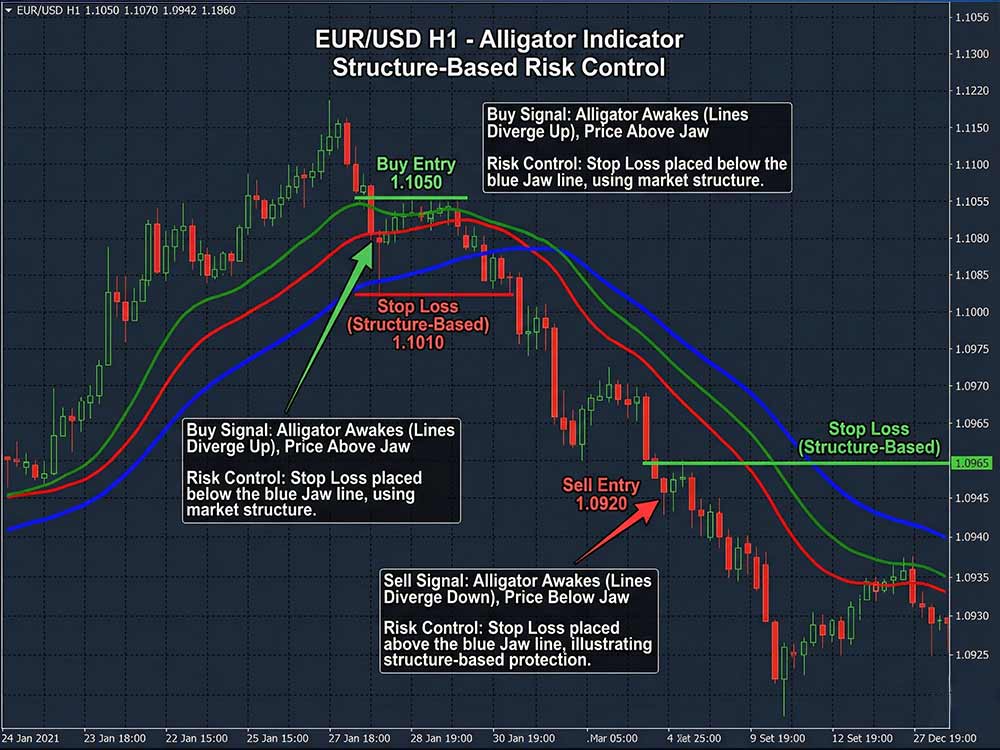
Risk management remains critical, even with a strong alligator indicator setup.
For buy trades:
- Place stop-loss below the jaw or recent swing low
For sell trades:
- Place stop-loss above the jaw or recent swing high
This keeps stops outside normal volatility while protecting capital.
Effective stop-loss placement is key in trend-based systems like the Alligator Indicator - for a detailed framework on protecting your trades and career growth, check out forex stop-loss Strategies.
Best Alligator Indicator Settings for Forex
Many traders ask about the best alligator indicator settings. The default settings are:
- Jaw: 13-period SMMA, shifted 8
- Teeth: 8-period SMMA, shifted 5
- Lips: 5-period SMMA, shifted 3
These settings are widely used and effective across most forex pairs and timeframes. Beginners are advised not to change them until they fully understand how the alligator indicator works in live market conditions.
Best Timeframes for the Alligator Indicator
The alligator indicator can be applied to any timeframe, but it performs best where trends are cleaner. Traders focused on holding positions for longer periods often apply this logic alongside broader forex trading strategies, rather than short-term reactive systems.
Recommended forex timeframes:
- 1-hour
- 4-hour
- Daily
Lower timeframes increase noise and false signals, especially during ranging markets.
Common Mistakes When Using the Alligator Indicator
Trading During Sleep Phases
Ignoring the sleeping alligator leads to overtrading and losses.
Entering Too Early
A single line cross is not enough. Separation and slope matter.
Using the Indicator Alone
The alligator indicator should confirm trend, not replace price structure or risk management.
Chasing Price
The indicator rewards patience, not impulsive entries.
Combining the Alligator Indicator With Market Structure
The alligator indicator becomes more powerful when combined with:
- Support and resistance levels
- Higher-timeframe trend bias
- Breakouts from consolidation
This combination improves accuracy and confidence. You can check our guide on forex indicators to understand how these indicators work best together when combined and utilized in the right time frames.
Catch Stronger Trends With the Alligator Indicator
The alligator indicator is not about constant trading. It is about selective participation. By understanding how the alligator indicator works, learning how to read the alligator indicator, and applying disciplined entries and exits, traders can avoid low-probability setups and focus on real momentum.
To execute this approach effectively, traders benefit from trading conditions that support trend-following strategies, such as those offered by Dominion Options, which aligns well with alligator-based trading due to fast and reliable execution, raw spreads and 0.1 pips that reduce cost during multi-session trends providing clean charting and precise indicator behavior.
If you wait for the alligator to wake up and only trade while it is feeding, supported by an execution environment designed for momentum-based trading, your forex trading becomes calmer, more structured, and far more consistent over time.
FAQ: Alligator Indicator in Forex Trading
1. What is the alligator indicator best used for?
The alligator indicator is best used to identify trending conditions and avoid range-bound markets.
2. Is the alligator indicator good for beginners?
Yes. Its visual structure makes it easier to understand trend behavior and discipline.
3. Can the alligator indicator be used alone?
It can, but it performs better when combined with price action and basic structure analysis.
4. How accurate is the alligator technical indicator?
It is reliable for trend identification but, like all indicators, should not be used without risk management.