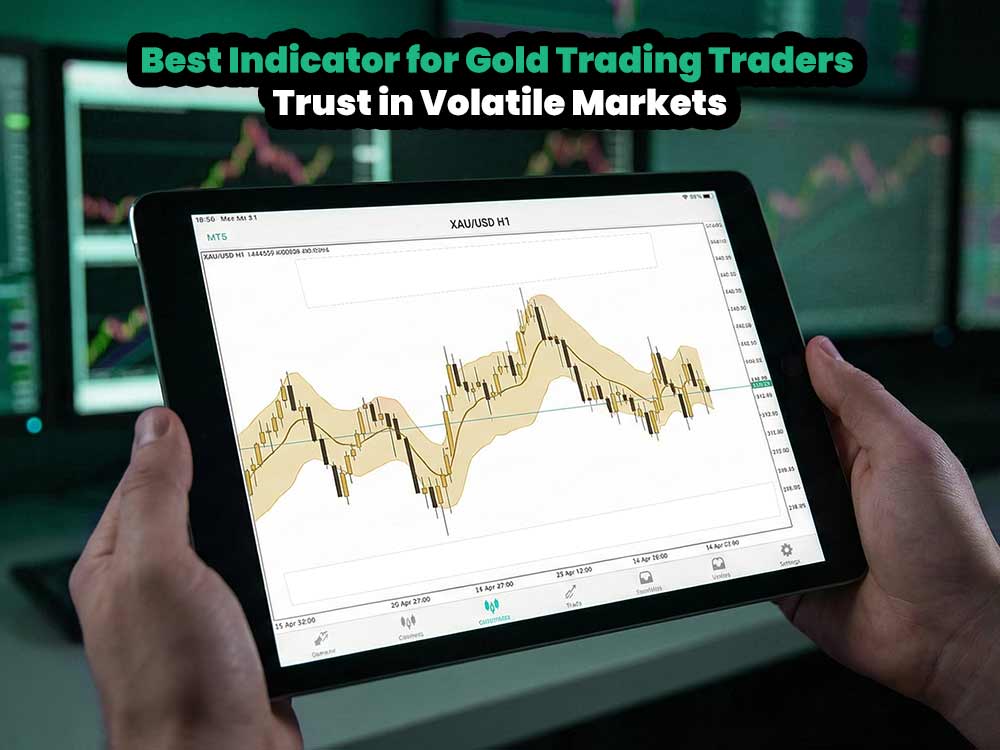
Best Indicator for Gold Trading Traders Trust in Volatile Markets
Gold trading attracts traders because of its sharp moves and clear reactions to global events, but those same traits also make it difficult to trade without structure. Price can surge or collapse within minutes, often ignoring short-term logic and punishing hesitation. In volatile conditions like these, traders do not rely on instinct or guesswork. They rely on an indicator for gold trading that helps them stay objective when emotions rise.
No single indicator for gold trading works well in all market conditions, and most experienced traders come to terms with this early in their journey. Rather than chasing a perfect tool, they focus on gold indicators for trading that help them read price behavior, judge momentum strength, and cut through excess noise when markets become unstable.
This is also why gold traders pay close attention to execution quality and pricing, often choosing brokers like Dominion Options, where tight spreads on XAUUSD, stable MT5 execution, and clean price feeds allow any best indicator for gold trading to reflect real market movement instead of distorted pricing. The indicators traders trust most are not complex or flashy. They are proven, readable, and dependable under pressure.
This article explains the best indicator for trading gold during volatile markets, why these tools work, and how traders combine them to improve decision-making and control risk.
Why Gold Requires a Different Trading Approach
Gold behaves differently from most currency pairs and equity markets. It reacts sharply to inflation data, interest rate decisions, geopolitical tension, and sudden shifts in risk appetite. Gold often reacts violently during periods of uncertainty, as seen during recent moves when gold approached record levels amid global risk concerns. These reactions tend to appear suddenly, often without warning, and can lead to rapid expansions followed by equally sharp reversals.
These sudden moves often happen in seconds, which is why execution quality and slippage become critical factors during volatile gold sessions.
Because of this behavior, lagging tools often fail, while overly sensitive gold indicators for trading produce constant false signals. Gold traders learn that clarity matters more than speed. A reliable indicator for gold trading must explain what price is doing now, not what it did several candles ago.
The most trusted best indicators for gold trading share three qualities. They respond well to volatility, define trend direction clearly, and confirm whether price moves are supported by real market participation.
What Makes an Indicator for Gold Trading Reliable in Volatile Markets
What Makes an Indicator for Gold Trading Reliable in Volatile Markets
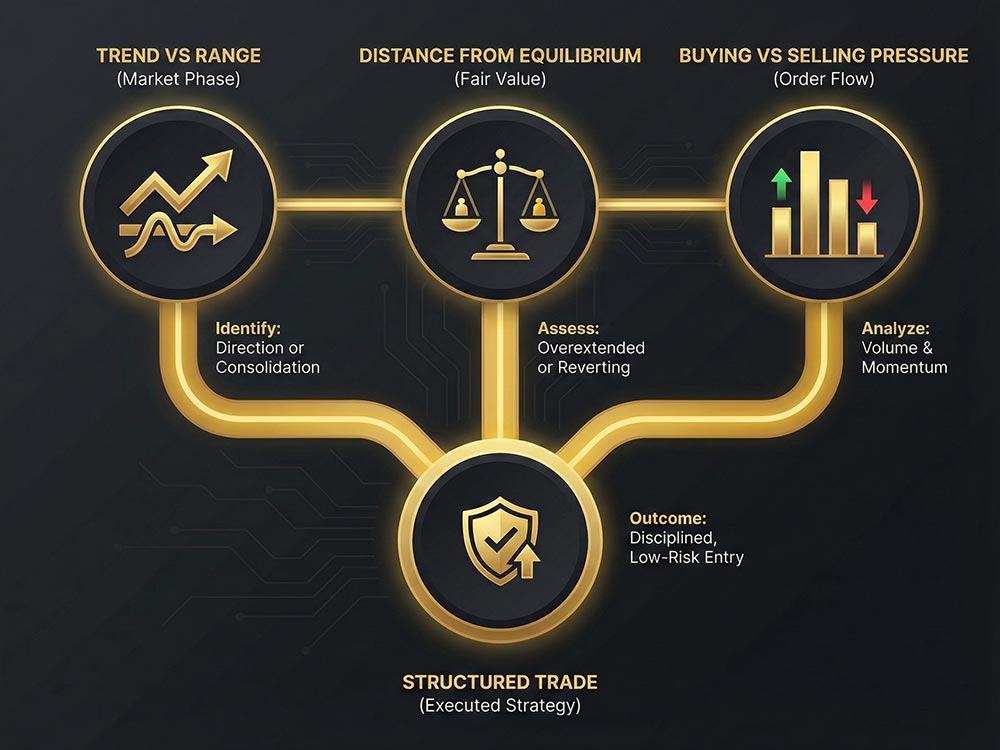
Indicators exist to bring structure to uncertainty, especially when price moves aggressively. In volatile gold markets, an indicator for gold trading helps traders answer critical questions before committing capital.
Most traders want to know whether gold is trending or ranging, whether price has moved too far from equilibrium, and whether the move is backed by real buying or selling pressure. When these questions remain unanswered, trades often become emotional rather than structured.
Gold trading indicators do not predict the future or eliminate losses. It supports discipline, helps traders avoid impulsive entries, and enforces logical trade management during periods of high volatility.
The most trusted indicator for gold trading shares a few non-negotiable characteristics.
-
1. Clear reaction to volatility
Gold moves fast, so lagging indicators often fail. The best gold indicators for trading respond quickly without producing constant false signals.
-
2. Ability to define trend direction
A reliable gold trading indicator must clearly show whether buyers or sellers control the market, especially during news-driven sessions.
-
3. Momentum confirmation
The best indicator for trading gold confirms whether price movement is supported by strength, not just temporary emotion.
-
4. Compatibility with other tools
Professional traders rarely use one indicator alone. Strong gold indicators for trading work well when combined with trend or volume tools.
-
5. Consistency across timeframes
The best indicator for gold trading should perform logically on both intraday and higher timeframes without drastic behavior changes.
Trading indicators only work when traders understand price behavior and confirmation, which is why knowing how to read forex charts remains essential.
Best Indicators for Gold Trading in 2026
Relative Strength Index (RSI) and Gold Momentum
The Relative Strength Index remains one of the most widely used gold indicators for trading because it measures momentum rather than direction. This distinction matters because gold can continue pushing higher or lower even as momentum begins to fade.
As a gold trading indicator, RSI helps traders evaluate whether buying or selling pressure is weakening, especially near key support and resistance zones. Many traders use a 14-period RSI with 70 and 30 levels, while others adjust to 75 and 25 during high-volatility conditions.
RSI works best as a confirmation tool rather than a standalone signal. When price makes new highs without RSI confirmation, it can suggest exhaustion. When RSI holds steady during pullbacks, it often supports trend continuation, making it one of the best indicators for trading gold when paired with trend tools. RSI works well for gold, but many traders also use broader tools from the forex market, which we cover in our guide on best indicator for forex trading.
Moving Averages (MA) as the Foundation of Trend Analysis
Moving Averages (MA) as the Foundation of Trend Analysis
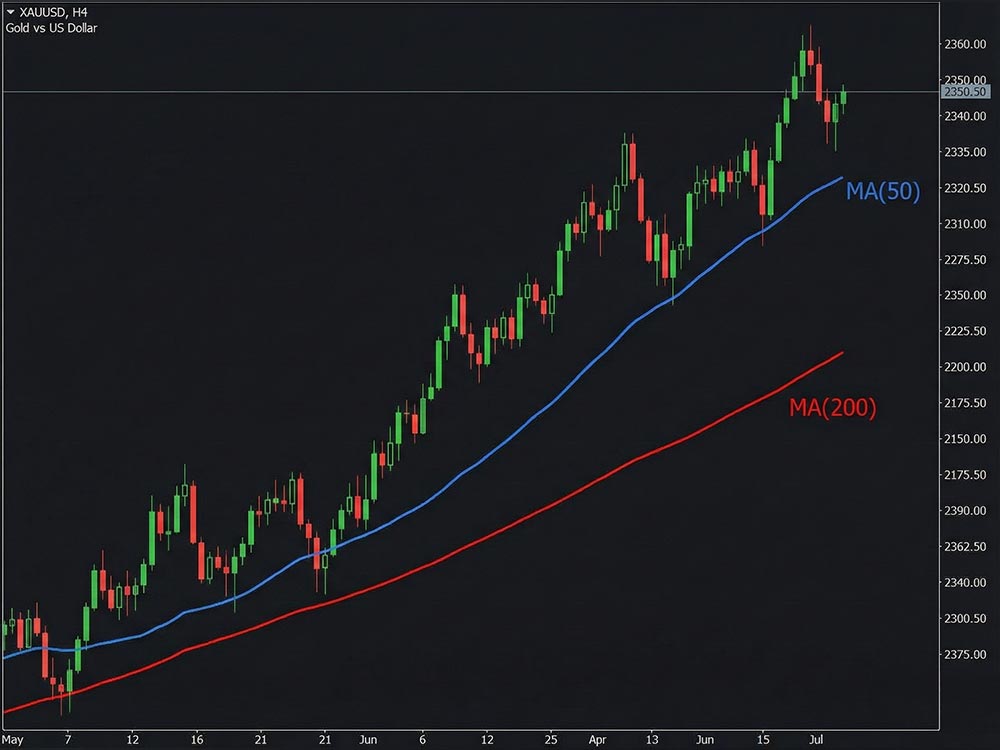
Moving averages form the backbone of most indicator for gold trading strategies. Gold respects moving averages particularly well on higher time frames where institutional volume dominates.
Simple moving averages help define structure, while exponential moving averages react faster and assist with timing. Popular combinations include the 20 and 50 EMA for short-term direction and the 50 and 200 SMA for broader trend bias.
The real value of moving averages is not the crossover itself, but how price behaves around them. When price consistently holds above a key average, buyers remain in control. When it stays below, selling pressure dominates. This insight helps traders avoid trading against momentum, a common mistake in volatile gold markets.
MACD and Early Momentum Shifts
MACD and Early Momentum Shifts
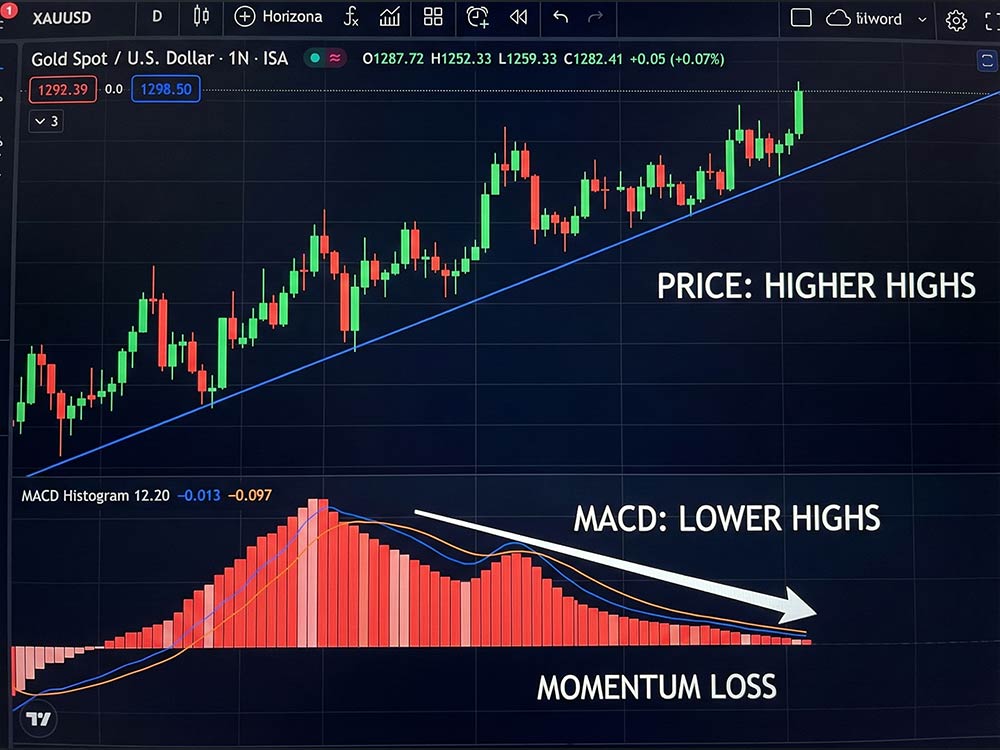
MACD is valued as an indicator for gold trading because it highlights momentum changes before they become obvious on price charts. Gold reversals often begin quietly, and MACD helps traders detect these shifts early.
By comparing two moving averages and a signal line, MACD highlights weakening momentum, divergence, and early trend changes. Traders focus on line crossovers, fading histogram bars, and divergence when price continues moving while momentum stalls.
MACD performs best when gold is already trending and loses reliability in sideways conditions. For this reason, many traders combine it with moving averages to ensure alignment with the broader market direction. Many traders apply these same momentum tools directly on MT5, which is why we also break down the best MT5 indicators.
Bollinger Bands and Volatility Awareness
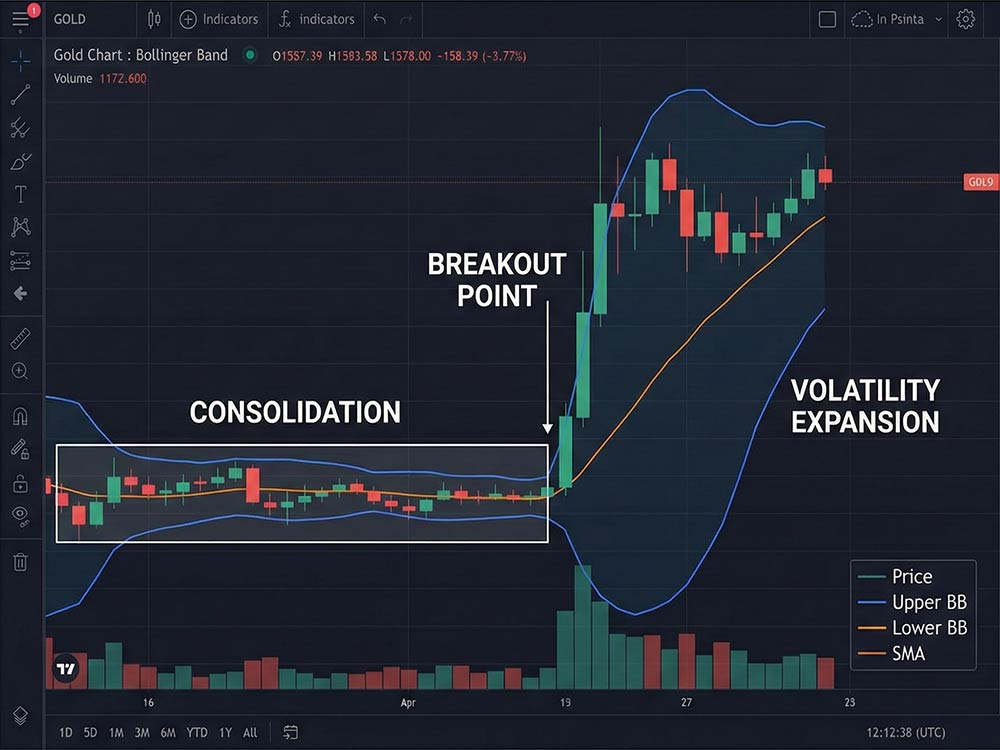
Bollinger Bands and Volatility Awareness
Volatility is central to gold trading, and Bollinger Bands remain one of the most popular gold indicators for trading volatility. As volatility increases, the bands widen. When price consolidates, the bands tighten.
A common mistake is treating a touch of the outer band as an automatic reversal. In strong gold trends, price can ride the bands for extended periods. The true value of Bollinger Bands lies in identifying volatility expansion and contraction.
When bands compress, traders prepare for explosive moves. When they expand rapidly, traders avoid chasing price. Combined with momentum tools, Bollinger Bands become a powerful best indicator for gold trading volatility.
Volume as a Critical Confirmation Tool
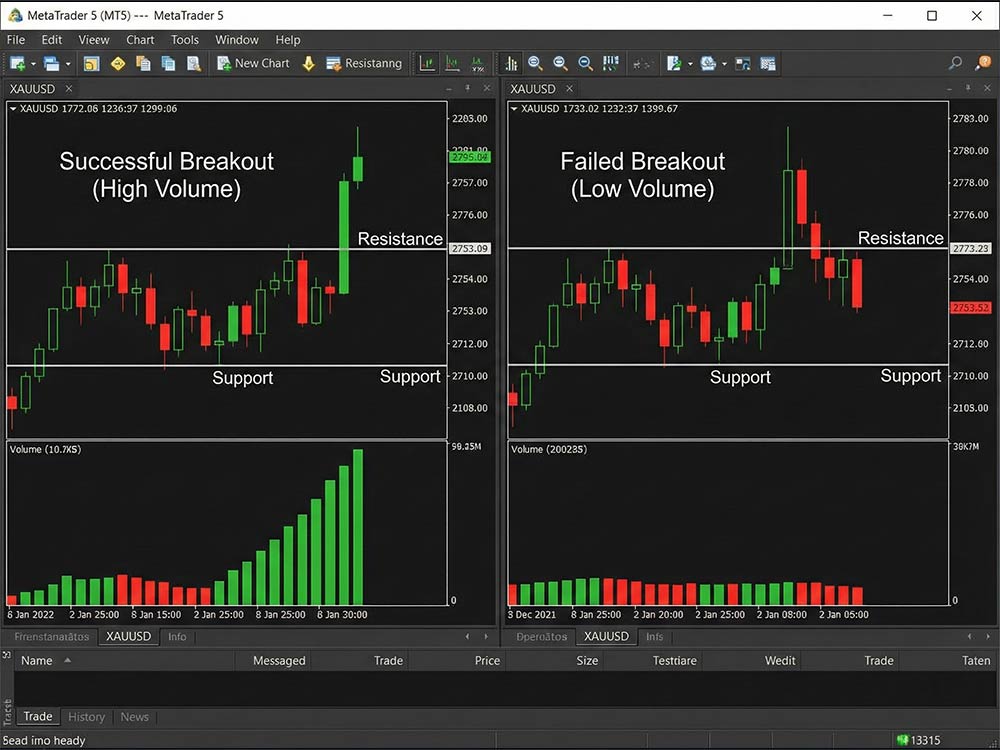
Volume as a Critical Confirmation Tool
Volume is one of the most overlooked yet critical components of any indicator for gold trading setup. While volume does not trigger entries on its own, it confirms whether price movement is supported by real participation.
Gold breakouts accompanied by strong volume are far more likely to continue, while moves on weak volume often fail. In fear-driven gold markets, volume exposes whether traders truly agree with the direction.
Experienced traders rarely take breakout trades without volume confirmation, making it one of the most reliable gold indicators for trading trend validation.
Adaptive Moving Averages and Changing Market Conditions
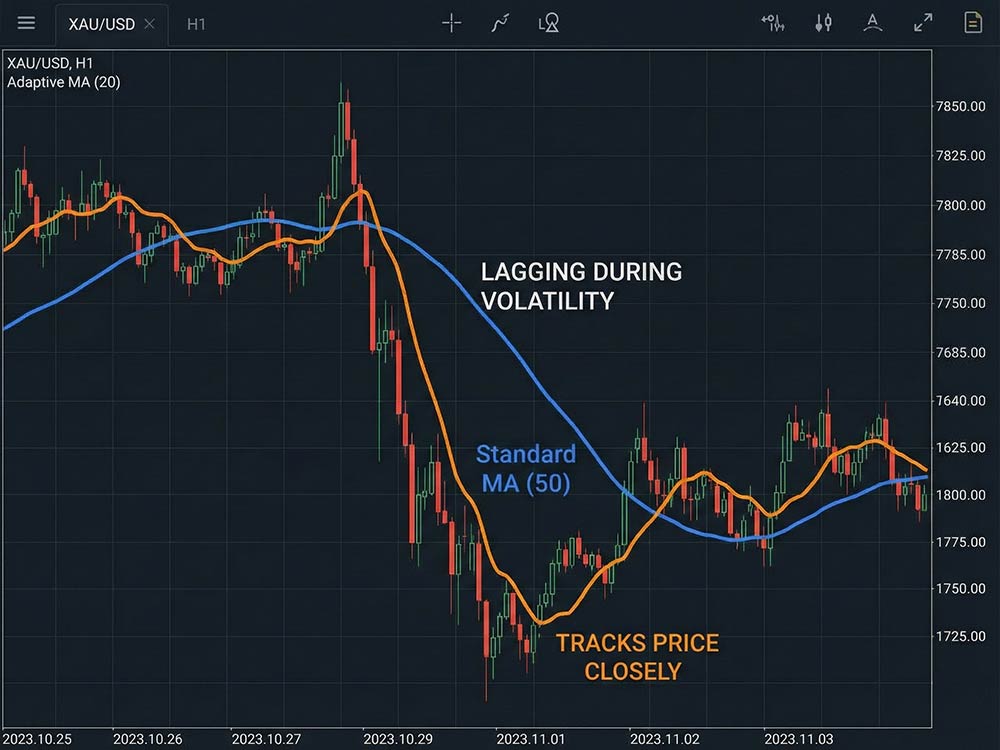
Adaptive Moving Averages and Changing Market Conditions
Adaptive moving averages adjust their sensitivity based on market conditions. This makes them especially useful as an indicator for gold trading, where volatility can change rapidly.
Traditional averages lag during sudden spikes, while adaptive versions stay closer to price without reacting to every minor fluctuation. Many intraday gold traders use them to track short-term trends and reduce whipsaws.
These tools work best as dynamic support and resistance rather than rigid entry signals.
Commodity Channel Index (CCI) and Short-Term Extremes
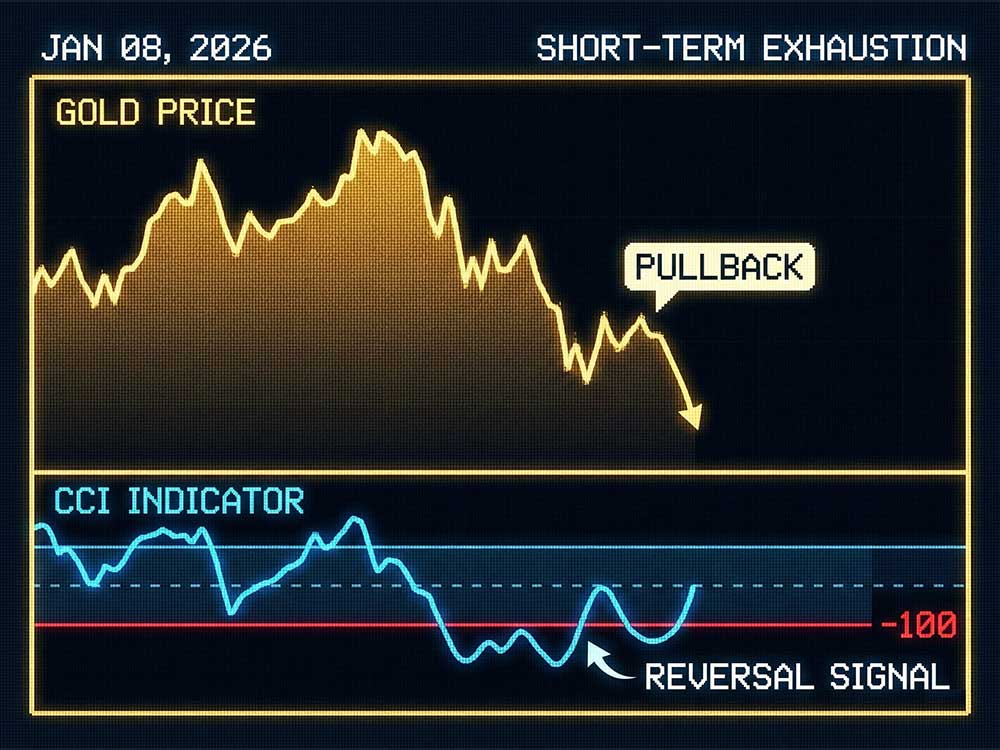
Commodity Channel Index (CCI) and Short-Term Extremes
The Commodity Channel Index measures how far price deviates from its recent average. As an indicator for gold trading, it helps traders identify short-term overextension.
Readings above +100 often suggest upside exhaustion, while readings below −100 indicate selling pressure may be fading. CCI performs best in ranging conditions and should be paired with trend filters in directional markets.
Used correctly, CCI helps traders time pullbacks rather than chase extended moves, making it a useful gold indicator for trading short-term conditions.
Keltner Channels for Cleaner Breakout Signals
Keltner Channels for Cleaner Breakout Signals
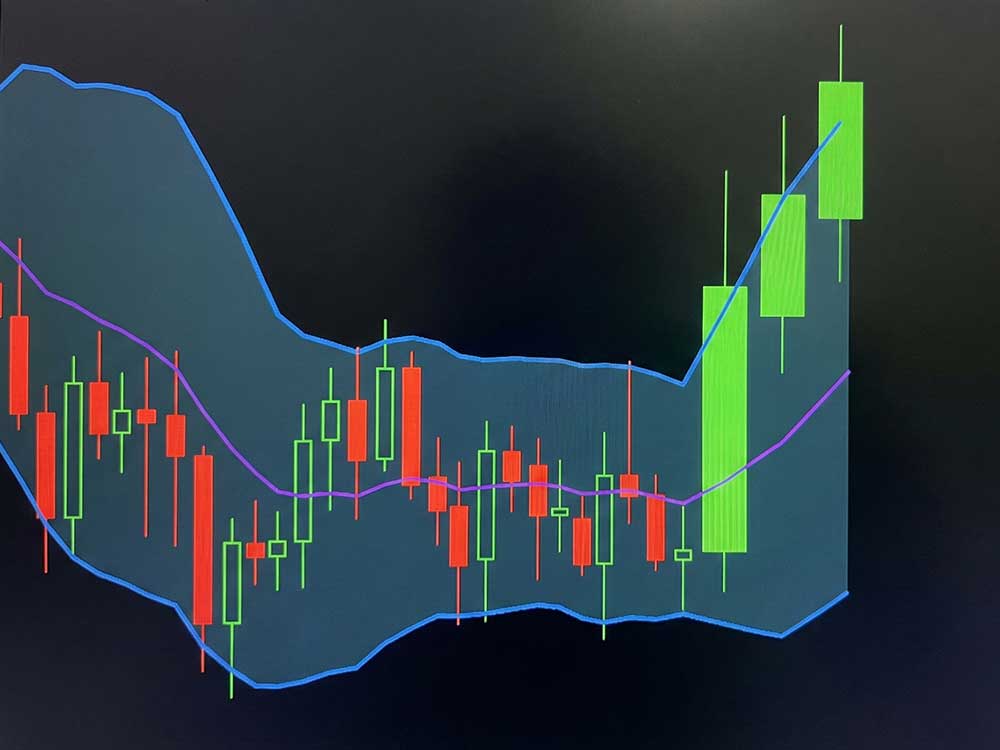
Keltner Channels are often preferred by traders who want a cleaner view of volatility, since they rely on average range rather than standard deviation. This approach tends to smooth out sudden spikes and makes it easier to focus on breakouts that have a better chance of holding.
When price closes outside the channel with momentum, continuation often follows. False breakouts occur less frequently than with more sensitive volatility tools, making Keltner Channels popular among breakout traders.
They work best when combined with momentum indicators that confirm strength rather than relying on price position alone.
VWAP and Institutional Price Awareness
VWAP and Institutional Price Awareness
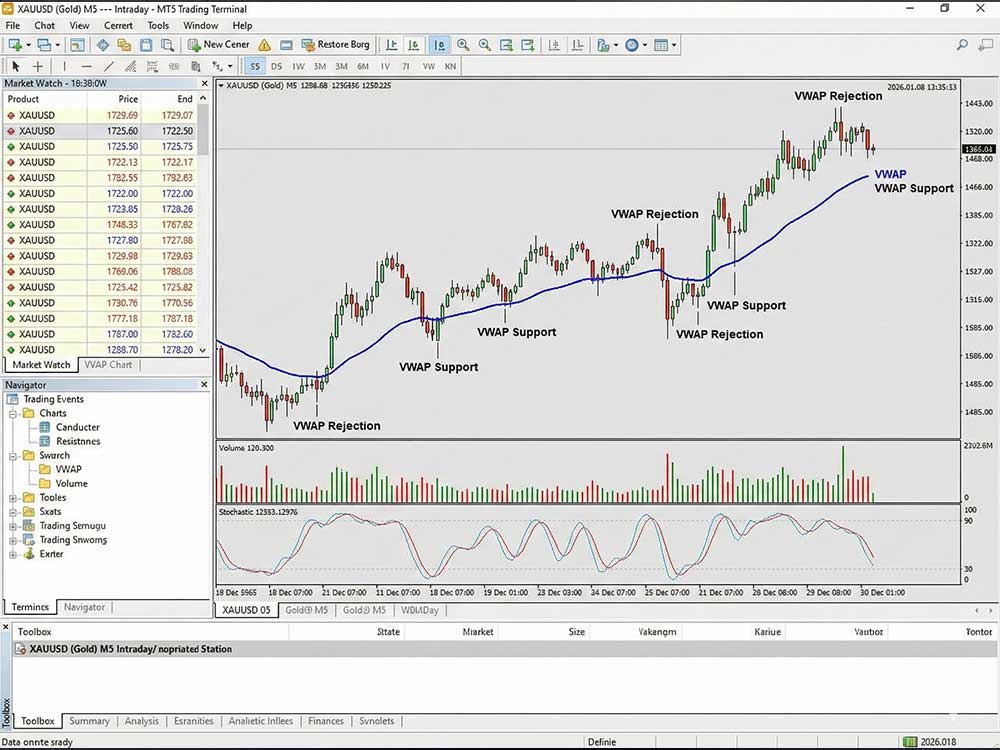
VWAP represents the average traded price weighted by volume and is closely watched by larger market participants. As an indicator for gold trading, VWAP often acts as a dynamic support or resistance level during active sessions.
When price trades above VWAP, buying pressure tends to dominate. When price remains below it, selling pressure is stronger. VWAP helps traders identify fair value and avoid chasing price far from equilibrium.
This tool is especially useful for intraday traders who focus on session-based movements.
Stochastic RSI for Timing Pullbacks
Stochastic RSI for Timing Pullbacks
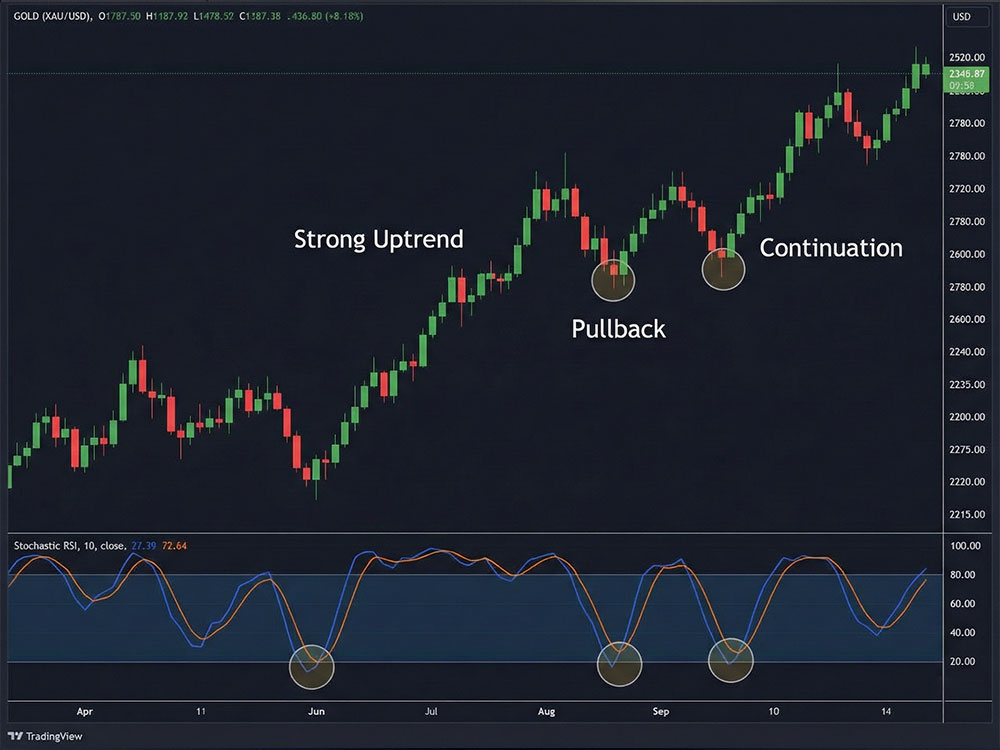
Stochastic RSI is a faster and more sensitive indicator for gold trading compared to traditional RSI, which makes it especially useful for timing pullbacks during strong trends. Traders often use it to fine-tune entries after short retracements, rather than chasing price during extended moves.
As one of the more responsive gold indicators for trading, Stochastic RSI reacts quickly when price temporarily retraces within an established trend. This helps traders avoid chasing extended moves and instead wait for short-term exhaustion before entering. Readings above 80 typically signal short-term overbought conditions, while readings below 20 suggest temporary oversold levels.
When used against the main trend, its signals tend to fail, but when aligned with moving averages or VWAP, it becomes far more reliable. Because of its speed, it requires strict rules and disciplined exits.
Because of its speed, Stochastic RSI requires discipline. Overuse leads to overtrading, but when applied selectively, it becomes a reliable best indicator for gold trading pullback entries in fast-moving markets.
Market Facilitation Index (MFI) and Fake Move Detection
Market Facilitation Index (MFI) and Fake Move Detection
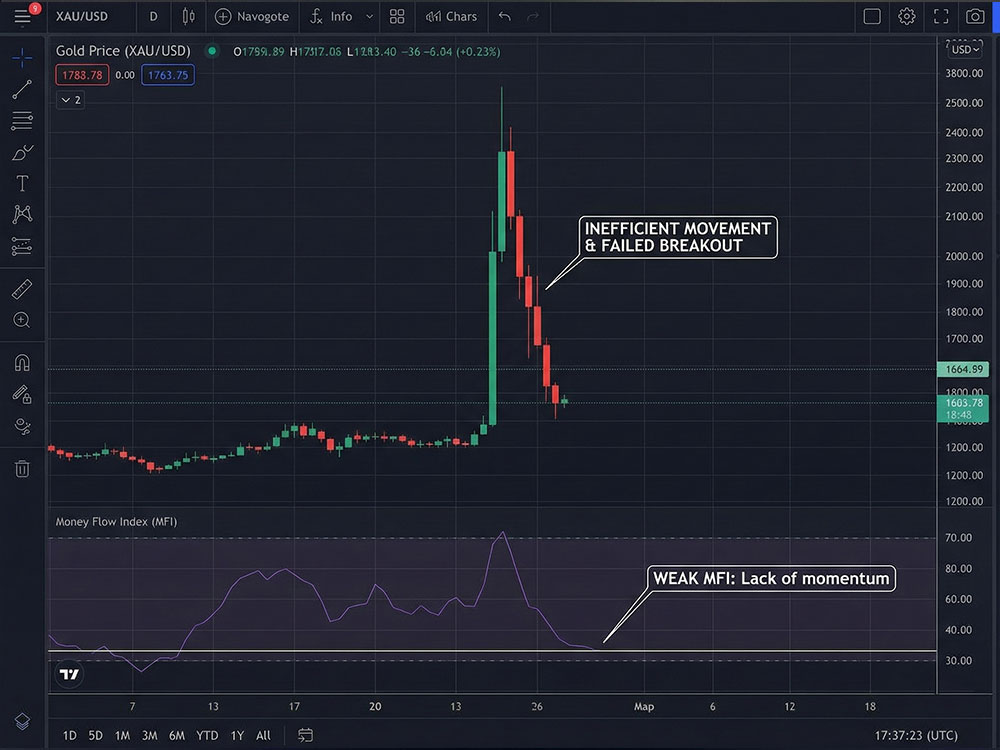
The Market Facilitation Index (MFI) is a lesser-known but powerful indicator for gold trading, particularly for identifying fake moves and weak breakouts. Unlike many traditional gold indicators for trading, MFI evaluates how efficiently price moves relative to volume, revealing whether momentum is genuine or deceptive.
Gold produces many sharp moves that lack real support. This indicator highlights when price moves occur without proper volume backing, warning traders of potential traps.
Used alongside volume analysis, the Market Facilitation Index acts as a filter rather than a trigger. It helps traders avoid entering low-quality setups and protects capital during chaotic conditions. For traders focused on confirmation rather than prediction, MFI complements other tools and strengthens any best indicator for trading gold strategy.
Trusted Indicator Combinations in Volatile Gold Markets
Professional traders rarely rely on a single indicator for gold trading. Instead, they combine tools that confirm trend, momentum, and participation when building structured gold trading strategies.
A common trend setup uses long-term moving averages to define direction and RSI to monitor momentum strength. Breakout traders often rely on volatility tools like Bollinger Bands or Keltner Channels paired with volume confirmation. Intraday traders frequently combine VWAP, adaptive moving averages, and MACD to follow session bias and time pullbacks.
These combinations reduce decision fatigue and improve consistency by limiting trades to clear conditions.
Why The Best Gold Trading Indicators Alone Are Not Enough
Gold markets tend to push traders to their limits, even those with strong discipline and experience. Gold trading Indicators cannot stop losses or make decisions for you, but they help bring structure to situations where price moves fast and emotions run high. Successful traders focus on execution rules, risk control, and proven trading strategies rather than chasing individual signals.
Traders who last in these conditions learn to cut losses early, manage position size carefully, and stay away from constant trading. Indicators support this process by reinforcing rules during volatile periods, while solid risk control remains the main factor that keeps accounts intact.
Without risk management, even the best indicators fail.
Choosing the Right Indicators for Your Trading Style
The best indicator for gold trading depends on how you trade. Short-term traders usually prefer tools that react quickly and help define session direction, while swing traders tend to do better with smoother indicators that allow more room for trades to develop.
Most traders end up choosing indicators based on their time frame, temperament, and how well they handle pressure. In fast-moving gold markets, simpler setups often hold up better than complex ones.
Different trading styles require different indicator behavior. Choosing the right indicator for gold trading depends on how you approach the market.
For Intraday Gold Traders
- VWAP for session bias
- Stochastic RSI for timing pullbacks
- Adaptive moving averages for fast trend shifts
These gold indicators for trading help manage rapid price changes during active sessions. many intraday traders rely on indicator combinations that filter noise and confirm momentum using proven day trading indicator setups.
For Swing Gold Traders
- Moving averages for trend structure
- RSI for momentum confirmation
- MACD for early momentum shifts
This combination forms a balanced best indicator for trading gold setup for multi-day moves.
For Breakout Traders
- Bollinger Bands or Keltner Channels
- Volume confirmation
- Market Facilitation Index for fake move detection
Together, they filter weak breakouts and strengthen any best indicator for gold trading breakout strategy.
Common Mistakes Traders Make When Using Gold Indicators
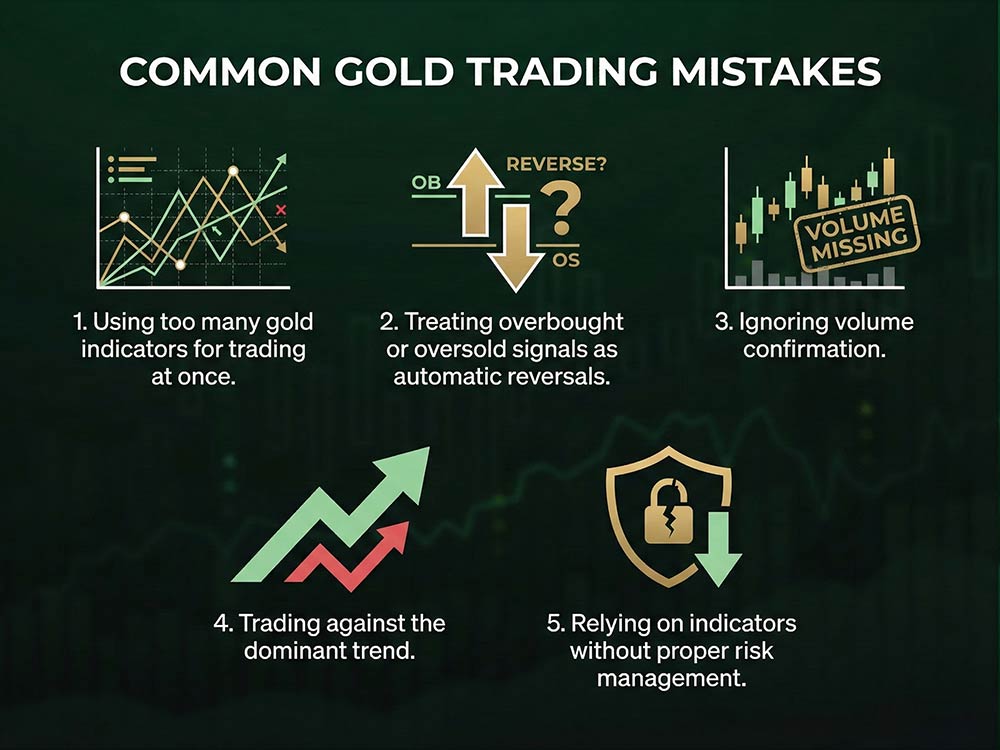
Common Mistakes Traders Make When Using Gold Indicators
Even the best indicator for gold trading can fail if used incorrectly.
- Using too many gold indicators for trading at once
- Treating overbought or oversold signals as automatic reversals
- Ignoring volume confirmation
- Trading against the dominant trend
- Relying on indicators without proper risk management
Most losses come from misuse, not from the indicator itself.
Final Thoughts
Gold is not an easy market and never really settles down for long. Forex traders who do well over time stop looking for certainty and instead, they tend to focus on building special routines that help them understand price behavior and keep emotions in check. Because remember, you can't trade with emotions.
Indicators for trading gold that traders tend to trust most are the ones that clarify direction, show whether momentum is holding, highlight changes in volatility, and confirm moves with volume.
When these gold indicators for trading are used together, they help bring order to markets that often feel unstable, especially when execution and pricing stay consistent, as traders expect when trading gold through forex trading brokers like Dominion Options offering 0.1 pips and tight spreads.
In gold trading, simple tools applied with discipline outperform complex systems built on hope.
FAQs: Best Indicator For Gold Trading
1. What is the best indicator for gold trading?
Most gold traders don’t rely on a single tool. The best indicator for gold trading is usually part of a simple setup that shows trend direction, momentum strength, and whether price movement is supported by volume.
2. Why do gold indicators for trading give false signals during volatility?
Gold indicators for trading struggle when price moves too fast or too slowly. Lagging indicators react late, while fast indicators can overreact and produce noise during sharp moves.
3. Can beginners use the same indicator for gold trading as experienced traders?
Yes, but experienced traders usually keep their setups simpler. A clean indicator for gold trading with clear rules often performs better than complex systems filled with multiple signals.
4. Is volume really necessary when using indicators on gold?
Yes. Volume helps confirm whether price movement is real or just a short-lived spike. Many traders consider volume essential when using any best indicator for trading gold.
5. Are gold trading indicators the same on MT5?
The indicators themselves stay the same, but execution speed and pricing can affect how signals play out. Clean execution matters more for gold than most markets.