Leverage Trading for Beginners: Your Shortcut to the Big Leagues — or a Fast Lesson
Leverage trading for beginners grabs attention fast. The pitch is simple: turn small money into big returns. You start with a little and control a lot. Gains come quick. Losses, even quicker.
That’s the part many skip. It’s easy to get caught up in the upside and miss the warning signs. You need to know both sides before diving in.
This guide breaks it down clearly. What leverage trading for beginners is. How it works. Where the danger lies. And how to avoid rookie mistakes. Read this first. Save yourself pain later. If you're wondering what is leverage or need forex leverage explained in simple terms, you're in the right place.
Join a platform built for smart trading, Dominion Options offers fair rules, clear pricing, and strong risk tools that help you stay in control. They also offer raw spreads starting from 0.1 pips, giving traders tighter costs and better entry points. And for those who want more room to maneuver, they support up to 500:1 leverage—just enough power when used with care. It’s one of the smarter choices when it comes to leverage trading for beginners.
What Is Leverage Trading for Beginners?
What Is Leverage Trading for Beginners?
Leverage trading for beginners means using borrowed money to open trades bigger than your actual account size. You only need to put up a small piece, called "margin."
Let’s say you want to trade $10,000 worth of currency. With 10:1 leverage, you only need $1,000 in your account. The broker lends you the other $9,000.
Here’s another example:
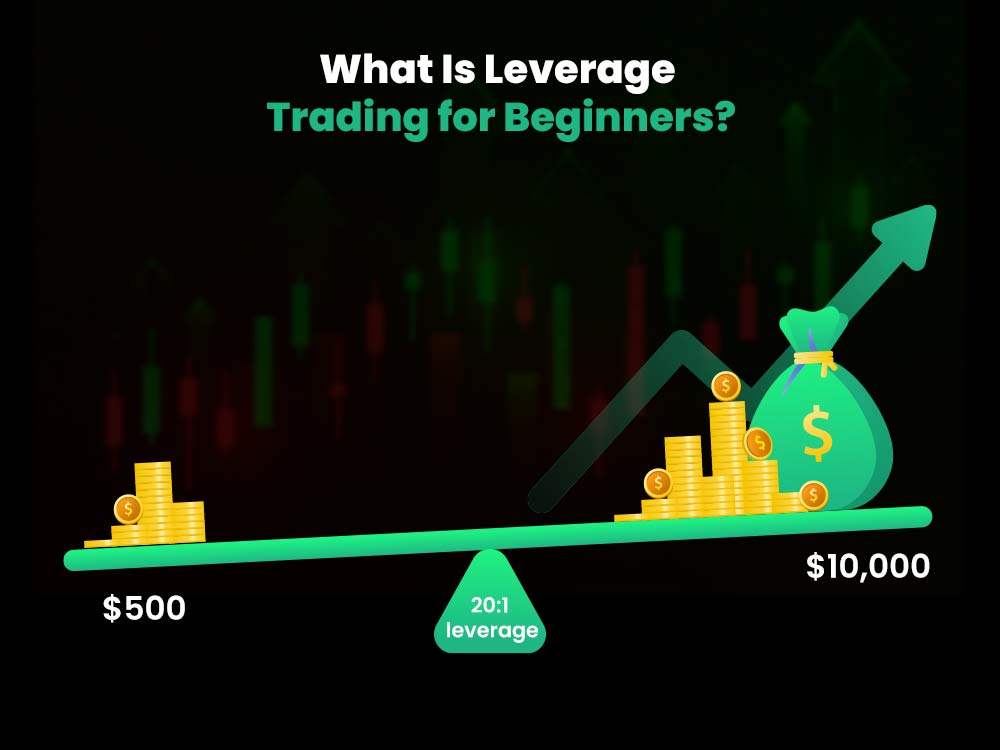
- You deposit $500.
- You use 20:1 leverage.
- You now control $10,000 in trade size.
That’s the power of leverage. But it works both ways. A small move in the market can lead to big wins or fast losses.
Here’s what leverage trading for beginners often looks like:
- You deposit a small amount (your margin).
- The broker multiplies your buying power.
- You open trades much larger than your deposit.
- A tiny market move affects your whole position.
- Profits and losses scale with that full position—not just your margin.
So, if you’ve ever asked what is leverage or needed forex leverage explained in action, this is it in simple terms. For beginners we also advise to check our article about forex trading for beginners.
What Is Margin in Leverage Trading?
Margin is the money you must have in your account to open a trade. It’s your part of the deal—a small amount that lets you control a much bigger trade.
Think of it as your skin in the game. The broker lends you the rest, but that margin is at risk.
Example trade:
- You want to open a $50,000 trade.
- Using 25:1 leverage, you only need to put down $2,000.
- That $2,000 is your margin. The broker covers the remaining $48,000.
If the trade gains 2%, your profit is $1,000. That’s a 50% return on your margin.
But if the market moves against you by 2%, you lose $1,000—half your margin, gone fast.
Here's what margin means in practice for leverage trading for beginners:
- It's your upfront deposit.
- It decides how big a position you can open.
- It limits how far the trade can go against you.
- If your losses hit the margin level, your broker may close the trade.
- If losses go beyond that, you might owe more unless there's negative balance protection.
Managing your margin effectively is one of the most important skills in leverage trading for beginners.
Long and Short Positions in Leverage Trading for Beginners
Long and Short Positions in Leverage Trading for Beginners
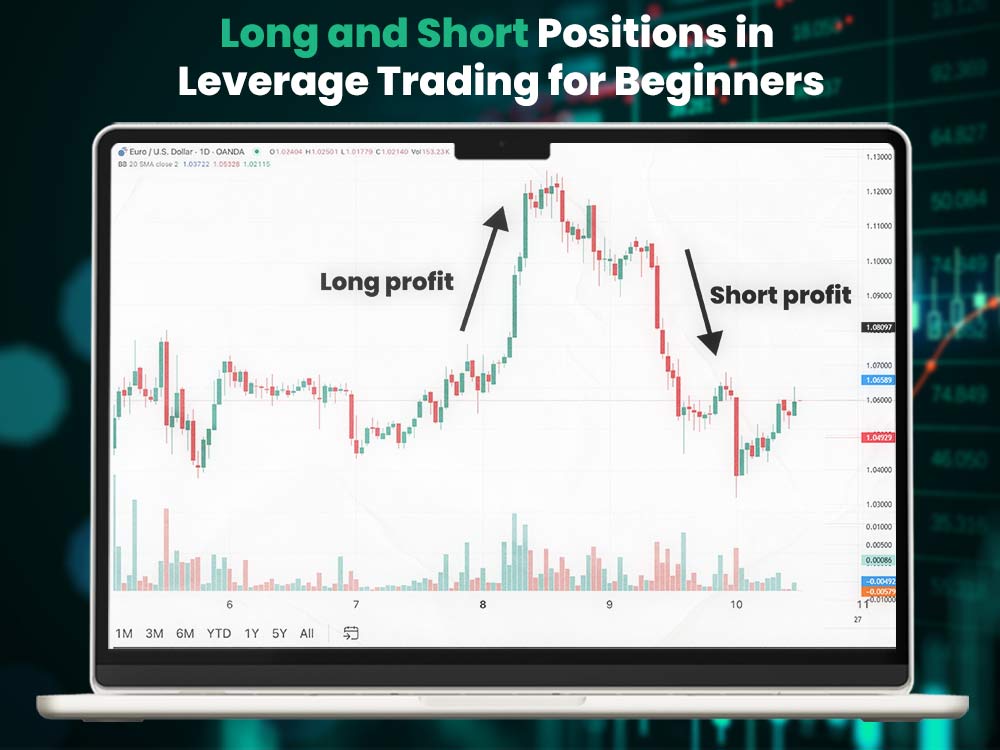
You can profit whether the market moves up or down—if you understand how to position your trades.
- Going long means you buy first, expecting the price to rise. You sell later at a higher price to profit.
- Going short means you sell first, expecting the price to fall. You buy later at a lower price to profit.
For example:
- You go long on EUR/USD at 1.1000 with a 10:1 leverage.
- If the price rises to 1.1050, that's a 50-pip gain.
- With a $1,000 margin, you could earn around $500 depending on position size.
On the flip side:
- You go short on the same pair at 1.1000.
- If it drops to 1.0950, you also earn 50 pips.
Here’s how to think about long and short positions:
- Long = buy low, sell high
- Short = sell high, buy low
- Both let you trade trends—up or down
- Leverage boosts both your profits and your risk
- The market doesn’t care which way you trade—just get the direction right
Leverage applies to both strategies. That’s why clear entry, exit, and risk levels matter no matter how you trade. If you're using high leverage, make sure you're working with one of the trusted high leverage forex brokers who offer proper risk tools and protection. These strategies are essential in leverage trading for beginners to avoid unnecessary losses.
Understanding Pips While Trading Gold/USD
A pip is the smallest price move in forex. It’s usually 0.0001 for most currency pairs. For gold and other commodities, the pip size may differ.
Example:
- EUR/USD moves from 1.1000 to 1.1005.
- That’s a 5-pip move.
Now let’s take gold (XAU/USD) as an example:
- Gold moves from 1925.50 to 1926.00.
- That’s a 50-pip move if your broker counts every $0.01 as a pip.
Pips may look small. But with leverage, they carry weight. Check out our article on what is a pip to further understand this as a beginner.
Understanding Pips While Trading Gold/USD
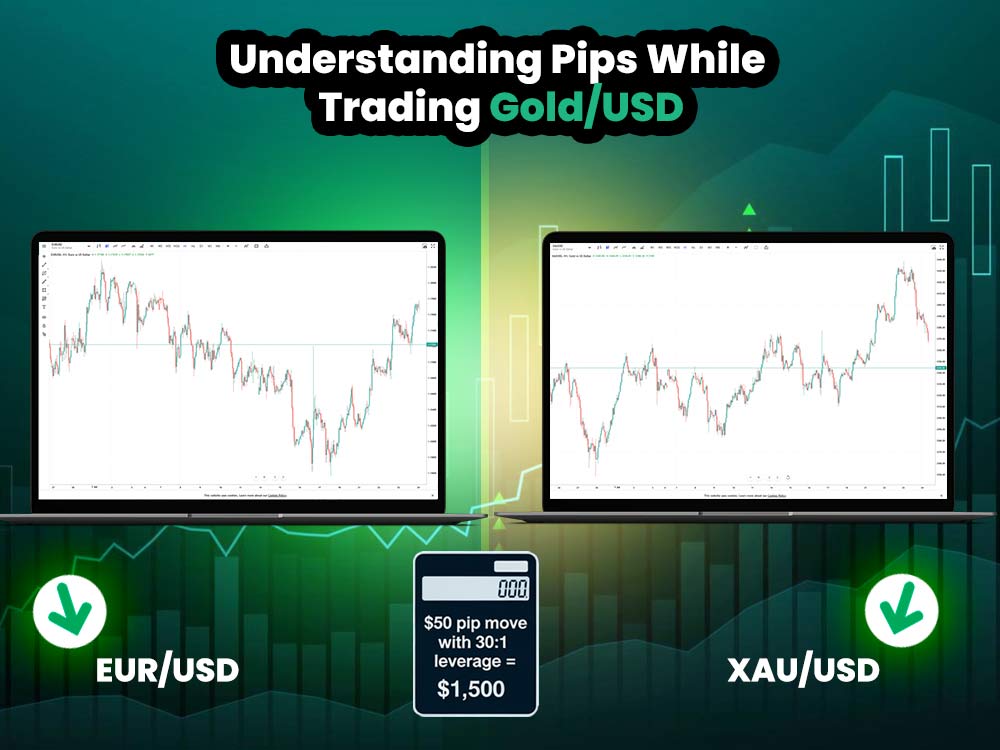
Let’s say one pip is worth $1:
- A 50-pip move equals $50.
- With 30:1 leverage, that $50 impact can multiply to $1,500—either profit or loss, depending on direction and size.
Here's how pips and leverage work together in leverage trading for beginners:
- Small price changes can mean big money.
- Pip value varies based on the asset and lot size.
- Commodities like gold often move in larger increments.
- Leverage turns small moves into major outcomes.
- Always know your pip value before entering a trade.
Understanding how pip movements affect your trades is key for leverage trading for beginners who want to stay in control.
Risk Management Tools for Beginners
Leverage can drain your account fast. One bad trade can eat up your margin in minutes. Imagine this:
- You open a $20,000 trade on gold using 20:1 leverage.
- Your margin is $1,000.
- Gold drops just 1.5%.
- You lose $300. A few more small moves and your margin is nearly gone.
When that happens, you might get a margin call. That means you need to add more funds, or your broker will close the trade to limit their risk.
It doesn’t stop there. In some cases, if the market moves too fast, your losses can go beyond your deposit. You could end up owing money.
Here’s what to watch for in leverage trading as a beginner:
- Thin margins: Small losses add up quickly.
- Volatile markets: Sharp moves can trigger instant losses.
- No stop-loss: Trades left open can spiral fast.
- High leverage: Even minor market shifts hit hard.
That’s why risk management matters. Understand the risks of high leverage trading before you go all in. It could save your account—and your confidence.
Common Mistakes Beginners Make During Leverage Trading
Even with the right tools, mistakes happen—especially when you're new.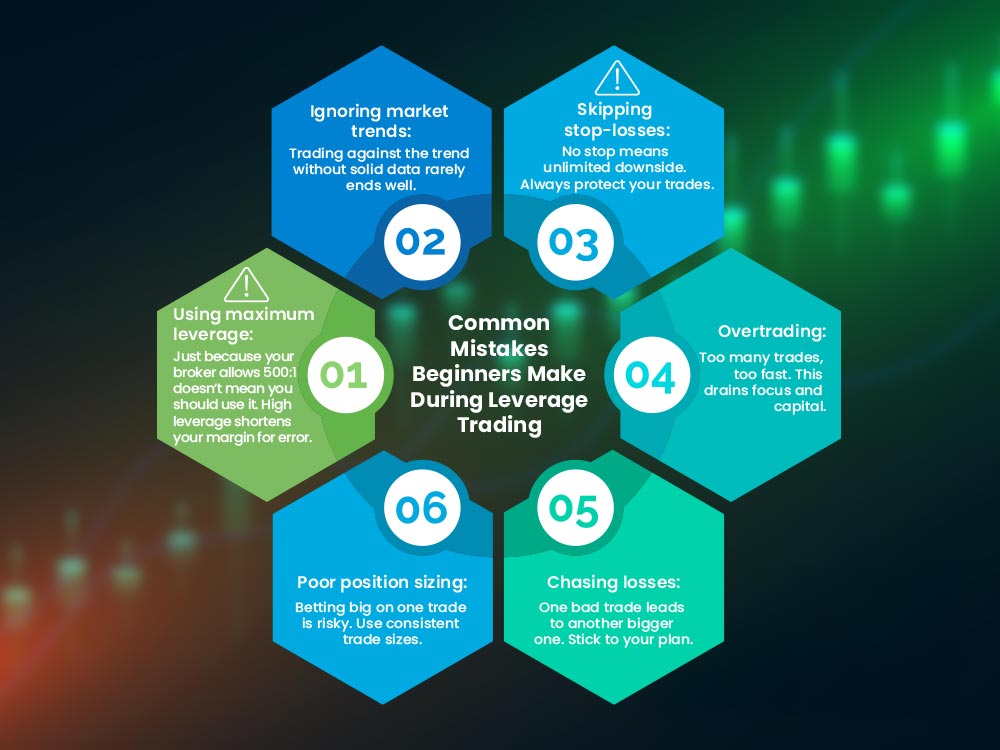
Understanding Pips While Trading Gold/USD
These are the most common mistakes beginners make during leverage trading:
- Using maximum leverage: Just because your broker allows 500:1 doesn’t mean you should use it. High leverage shortens your margin for error
- Ignoring market trends: Trading against the trend without solid data rarely ends well.
- Skipping stop-losses: No stop means unlimited downside. Always protect your trades.
- Overtrading: Too many trades, too fast. This drains focus and capital.
- Chasing losses: One bad trade leads to another bigger one. Stick to your plan.
- Poor position sizing: Betting big on one trade is risky. Use consistent trade sizes.
Avoiding these common trading mistakes is part of mastering leverage trading for beginners. Take your time, stay consistent, and keep your strategy simple.
Choosing the Right Leverage as a Beginner
How much leverage should you use? In leverage trading for beginners, this decision matters more than most.
- Start small: 5:1 or 10:1 gives you room to learn.
- Build experience: Once you're consistent, try 20:1 or 30:1.
- Avoid extremes: Leverage above 50:1 makes it too easy to blow your account.
- Match it to your style: Day traders use different levels than swing traders.
The goal is control—not speed. In leverage trading for beginners, picking the right ratio keeps you in the game longer. Dominion Options makes that easier by offering flexible leverage up to 500:1, raw spreads from 0.1 pips, and built-in safety tools like negative balance protection—giving new traders more control without cutting performance.
Leverage Regulations You Need to Know
Different regions limit leverage to protect traders—especially beginners:
- U.S.: Max 50:1 on major pairs.
- UK/EU: Max 30:1 for retail traders.
- Australia: Similar limits as Europe.
These rules help reduce risk for new traders. If you're outside these regions, you may have access to higher ratios—but that doesn’t mean you should use them. Smart leverage trading for beginners is about safety, not size.
Can You Really Win at Leverage Trading?
Yes, but only if you treat it seriously. Leverage trading for beginners can be rewarding, but it’s not a shortcut to wealth.
- Have a simple, repeatable trading strategy
- Control your risk on every trade
- Use tools like stop-loss and take-profit orders
- Practice on a demo account before trading live
Many new traders blow up early. The ones who last? They treat it like a business.
If you're learning leverage trading for beginners, this mindset shift is everything.
Final Thoughts on Leverage Trading for Beginners
Leverage can boost your trades—but it can also knock you out. It’s powerful, fast, and unforgiving.
Stick to the basics:- Use low leverage when starting
- Follow the trend
- Protect every trade
- Manage your margin
And if you’re looking for a broker that helps you do all that, Dominion Options gives you the right tools from day one. You get raw spreads from 0.1 pips, up to 500:1 leverage, and protections like negative balance safeguards.
Leverage trading for beginners doesn’t have to be risky—if you stay disciplined and use the right platform.