
Margin Call in Forex: How to Prevent It from Wiping Your Account
Trading forex can grow a small account fast. But it can also wipe you out just as quickly. One of the biggest dangers is a margin call in Forex.
If you’re new, this is one of the most important concepts to learn before risking money. At brokers like Dominion Options, traders can manage this risk by using the right forex indicators and tools. With careful planning and safe setups, you can trade without pushing your account to the edge.
This guide explains everything about margin calls. You’ll learn why they happen, how to calculate margin call in forex, and how to avoid them.
What Is Margin Call in Forex?
A margin call in Forex is a warning from your broker. It tells you that your account equity has fallen too low to support your open trades.
Equity is your balance plus or minus profits and losses from open positions. When equity drops too close to the used margin, the broker alerts you. This means your available cushion is nearly gone, and your trades are at risk of being closed if the market keeps moving against you.
This is the core answer to what is margin call in forex: it’s a broker notification that your account is at risk. If you don’t act, the broker may close trades automatically to stop your losses from growing. This step is called stop-out, and it happens when your account no longer has enough margin to cover open positions. The broker starts shutting down trades, usually the biggest losers first, until the account balance is stable again.
Why Margin Calls Happen in Forex Trading

Why Margin Calls Happen in Forex Trading
- Price moves against you: Even small moves against your trade reduce equity quickly, eating into your free margin and pushing you closer to a margin call.
- Margin requirements rise: If your broker raises requirements, the same trades suddenly need more margin, leaving you with less room and increasing the chance of a call.
Both reasons mean your account can’t support current trades. That’s why margin calls matter - they warn you that your margin level is shrinking and your free margin is nearly gone. It’s a clear signal that your trading risk is too high and you need to adjust before the broker steps in. This is especially true if you rely on short-term methods like scalping strategies, where fast moves can drain margin quickly and bring you to a call sooner.
How a Margin Call in Forex Works
Let’s break down the steps.
- You start with $1,000.
- You open a trade needing $300 margin.
- Free margin is $700.
If the broker’s margin call level is 30%, the formula to calculate margin call in forex looks like this:
Minimum account value = Margin loan ÷ (1 – Maintenance margin requirement)
In this case:
- $300 × 30% = $90.
- If equity falls near this level, you’ll get a margin call in Forex.
That’s how fast it can happen. Just a small move can trigger it, because even a minor swing against your position reduces equity and eats into free margin. The less free margin you have, the closer you are to a margin call. This shows why keeping trades sized properly and watching equity is so important.
Margin Level: Explained
Brokers use margin level (%) to decide when to trigger a call.
The formula is:
Margin Level (%) = (Equity ÷ Used Margin) × 100
When this level hits the broker’s margin call threshold—often 100%—you get the warning. You may not be able to open new trades.
If it keeps falling to the stop-out level, usually 50%, the broker starts closing positions. That’s why watching margin level is critical.
Example: Small Moves Can Trigger a Margin Call
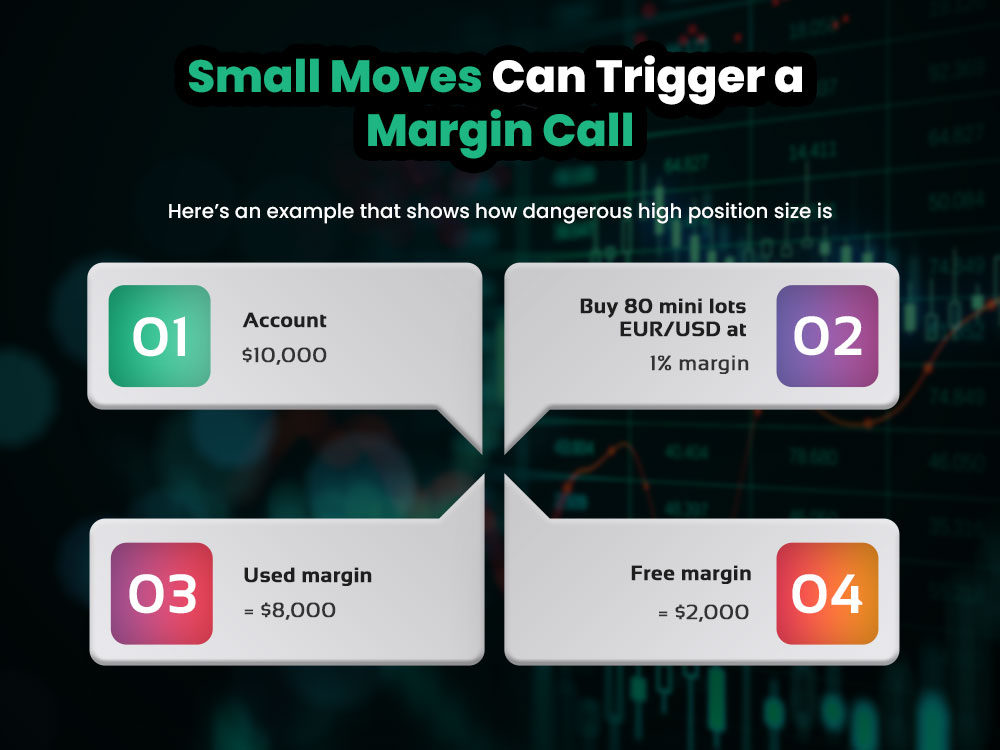
Small Moves Can Trigger a Margin Call
Here’s an example that shows how dangerous high position size is.
- Account: $10,000
- Buy 80 mini lots EUR/USD at 1% margin
- Used margin = $8,000
- Free margin = $2,000
Each pip is $80. A 25-pip loss burns $2,000. Add spread, and only 22 pips against you cause a margin call in Forex.
Margin Call vs. Stop-Out in Forex
It’s important to separate the two:
- Margin call in Forex: A broker warning. You can’t open new trades until equity improves.
- Stop-out: The broker closes losing trades to protect the account from going negative.
A margin call gives you a chance to act. Stop-out takes that chance away.
How to Avoid a Margin Call in Forex

How to Avoid a Margin Call in Forex
1. Use Correct Position Size
Trade small. Risk only 1–2% of your account per trade.
2. Always Use Stop-Loss
Protect every trade with a stop-loss. It may not be perfect, but it saves accounts by limiting how much you can lose on a single trade. Building simple stop-loss strategies gives you control over risk and helps you avoid the kind of large drawdowns that trigger margin calls.
3. Watch Margin Level
Check free margin and margin level daily. Don’t wait for a warning.
4. Avoid High Leverage
Don’t be tempted by high leverage offers. They make this alert more likely because even small moves can wipe out your free margin. This links directly to margin calls, because the impact of high leverage trading is that losses grow faster than expected, pushing your account toward a call much sooner.
5. Keep Extra Funds
Don’t trade with the bare minimum. A buffer helps during volatile moves.
6. Manage Risk Around News
News events can gap the market and trigger margin calls. Reduce exposure before major releases.
These steps which are a crucial step in risk management, make it far less likely that a margin call in Forex will ever hit your account.
7. Backtesting Before You Trade
Before going live, test your strategy on past data. Backtesting shows how your plan would have worked in real market conditions. By running backtesting on MetaTrader, you can spot weak points, adjust entries and exits, and build confidence before risking real money.
What to Do If You Get a Margin Call
- Deposit funds. Adding money raises equity and restores free margin.
- Close trades. Reduce positions to lower used margin.
Ignoring a this is risky. The next step is stop-out, where you lose control of which trades get closed.
Common Mistakes That Trigger Margin Calls

Common Mistakes That Trigger Margin Calls
Avoid these habits that often lead to margin call in Forex:
- Oversizing trades.
- Running multiple trades at once.
- Trading without stop-loss.
- Adding positions to losing trades.
- Trading blindly during high-impact news.
These mistakes cut free margin and increase the odds of margin calls.
Quick Tips
- Keep margin level above 200% whenever possible.
- Risk small percentages of your account.
- Treat free margin as a safety net.
- Exit losing trades early.
- Focus on steady growth, not quick wins.
Following these tips makes a margin call in Forex much less likely. Choosing the best pairs to trade also matters, since some pairs move more smoothly and with lower spreads, giving you more control over risk.
Final Thoughts
A margin call in Forex is not random. It’s the result of trading choices and poor risk control.
By learning how to calculate margin call in forex, keeping positions small, and using stop-loss orders, you can prevent it.
The goal is simple: stay in the game, but careful management keeps you trading for the long run.
Protecting yourself is one of the best moves any forex trader can make. At Dominion Options, traders get the benefit of low spreads and even 0.0 pip pricing, which helps reduce costs and gives more room before a margin call becomes a risk.